
HIO Fitting experts explain how the right wedge setup improves spin, control, and consistency in the short game.
Wedges are among the most frequently used clubs in a golf bag, yet many golfers often neglect them. They play a crucial role in key shots during a round: from bunkers, approaches from 60–80 meters, or delicate shots around the green. In our fitting everyday life at HIO, we repeatedly encounter common issues: unsuitable lofts and sole grinds, poorly combined sets, or significantly worn grooves. Our experience shows that the right wedge setup can significantly enhance consistency, spin, and control in the short game. A closer look at these scoring clubs is therefore worthwhile.
When Full-Face Grooves Really Make Sense
Many golfers intentionally open the clubface on bunker or lob shots, which often shifts the contact point toward the clubhead’s toe. Classic wedges often lack grooves in this area, resulting in noticeable spin loss and less control. Full-face wedges, however, have grooves across the entire clubface, providing much more forgiveness, especially on open shots.
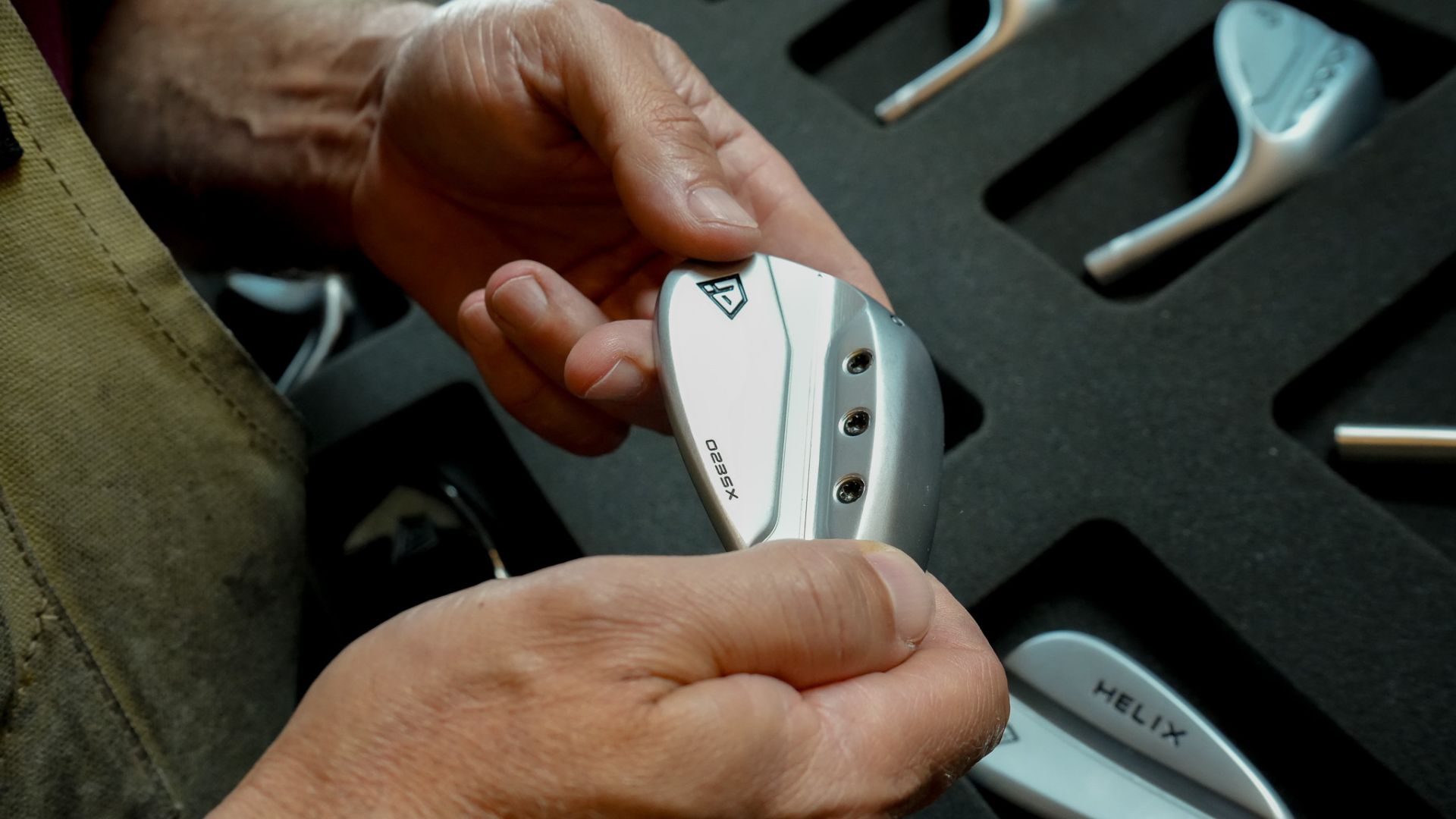
(Photo: HIO Fitting)
Sole Grind and Width for Improved Turf Interaction
The sole of a wedge significantly determines how the club interacts with the ground. A wider sole can provide more stability and forgiveness on soft turf or in bunkers. Importantly, it should not restrict opening the clubface. Modern wedge designs combine wide soles with targeted heel relief to allow open faces, low chips, or high flop shots even under difficult course conditions.
Loft Management: Often a 56° Wedge is Enough
Many amateurs carry both a 56° and a 60° wedge, but this is often unnecessary. A well-matched 56° wedge can be used versatilely by opening the face, producing similar height and spin as a 60° wedge but with higher control and consistency. The saved space in the bag can be better used for an extra fairway wood or mini driver.
Higher Center of Gravity for More Spin
Compared to irons or drivers, wedges should have a higher center of gravity. This promotes a flatter but spin-rich ball flight, resulting in better control when landing and stopping the ball on the green – a key factor in approach shots from medium and short distances.
Gapping – Even Distances for Clear Decisions
An effective wedge setup only works optimally when distances between clubs are sensibly distributed. Too large or too small gaps cause uncertainty and complicate club selection. G