
Experts at HIO Fitting reveal how the right wedge setup enhances spin, control, and consistency in the short game.
Wedges are among the most frequently used clubs in a golf bag, yet many golfers tend to underestimate their importance. They play a crucial role in many key shots during a round: from bunkers, approach shots from 60–80 meters, or sensitive play around the green. However, common fitting issues include mismatched lofts and sole grinds, poorly assembled sets, or heavily worn grooves. Our experience shows that the right wedge setup can significantly improve consistency, spin, and control in the short game. That’s why taking a closer look at scoring clubs is worthwhile.
HIO Guide: When Full-Face Grooves Really Make Sense
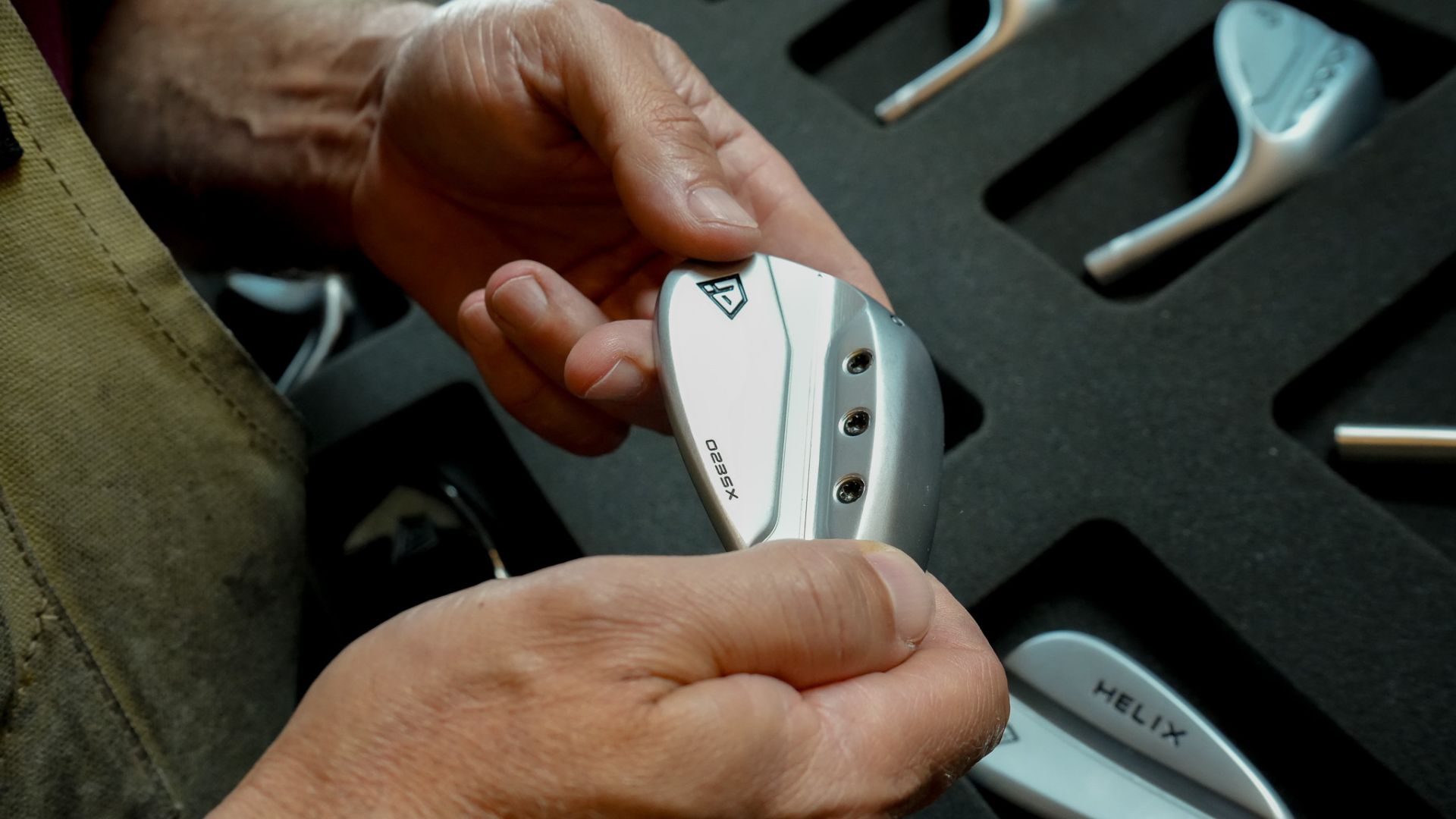
Many golfers intentionally open the clubface for bunker or lob shots, often shifting the impact area towards the clubhead’s toe. Traditional wedges usually lack grooves in this area, leading to noticeable spin loss and reduced control. Full-face wedges, in contrast, feature grooves across the entire clubface, offering greater forgiveness especially on open-faced shots.
(Photo: HIO Fitting)
Grind and Sole Width for Improved Turf Interaction
The sole of a wedge largely determines how the club interacts with the ground. A wider sole provides more stability and forgiveness on soft turf or in bunkers, but must not restrict opening the clubface. Modern wedge designs combine wide soles with targeted heel relief, allowing golfers to easily perform open-faced shots, low chips, or high flop shots—even in challenging course conditions.
Optimizing Loft Management and Wear Awareness
Many amateurs carry both a 56° and 60° wedge, but often a well-chosen 56° wedge used with an open face can achieve similar trajectory and spin to a 60°, while offering greater control and consistency. The saved bag space can then be used for an additional wood or mini-driver. Compared to irons or drivers, wedges should have a higher center of gravity to promote a lower, spin-rich ball flight, enabling better control on approaches from mid to short distances.
Proper gapping between wedges is crucial to avoid confusion, as small loft differences can create large distance gaps. Adjusting lofts by 1–2 degrees can create even gaps, best achieved by professional fitting and club bending.
Regarding gap wedges (usually 48–50°), many automatically choose a classic wedge, but a matching iron in the same loft can offer better forgiveness and feel, improving consistency on full approaches.
Wedges wear out faster than irons due to