Categories
Europe Travel

Golf at its best in the Garden of England

Spoilt for choice

Of the more than 1,900 English golf courses, around one hundred are located in Kent, England’s oldest county. On our eight-day round trip by car, we get to know some of its exceptional courses, which completely captivate us.

Sandwich to start

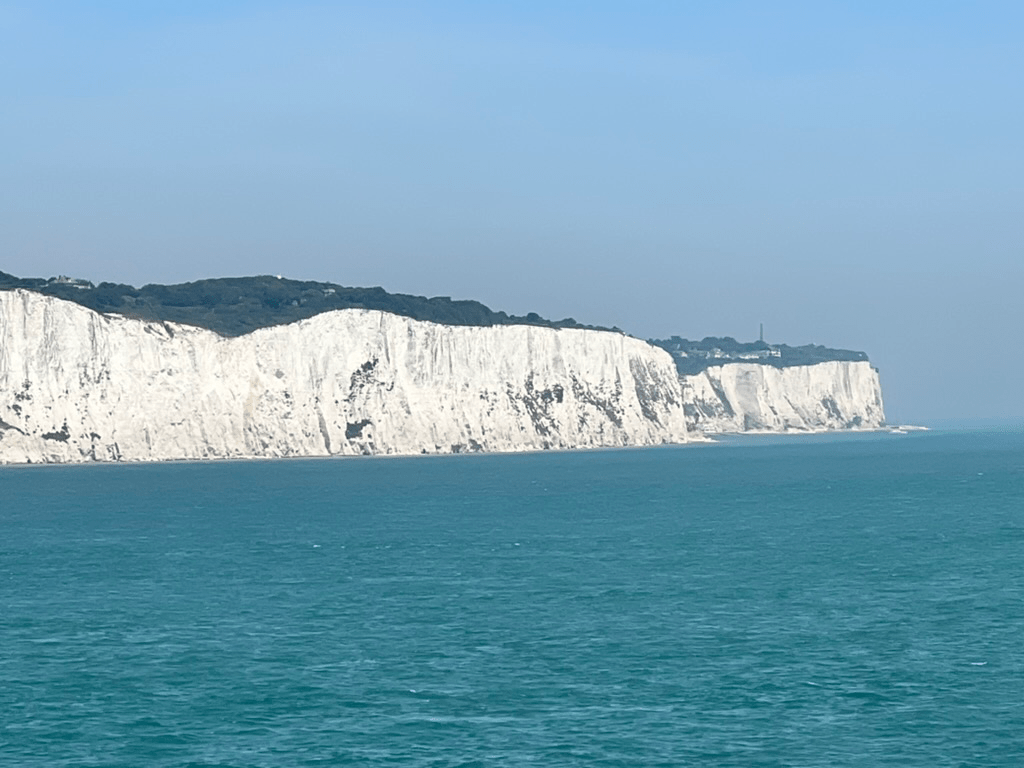
From the harbour in Dunkerque in France, the quiet ferry ride across the English Channel takes two hours to reach Dover, whose white chalk cliffs shine in the sun.

Leuchtende Kreidefelsen bei Ankunft der Fähre in Dover (Foto: Jürgen Linnenbürger)
Glowing chalk cliffs on arrival of the ferry in Dover (Photo Juergen Linnenbuerger)

From here it is only 20 minutes to the dreamy village of Sandwich, which is the best-preserved medieval town with the most half-timbered houses in England.

Sandwich is still one of the original famous ‘Five Harbours’, although unlike the other four towns of Dover, Hastings, Hythe and Romney, it no longer has direct access to the sea.

The popular snack of the same name is said to owe its name to an ‘Earl of Sandwich’ who, due to time constraints, often refrained from taking a full lunch. Instead, he opted for a slice of beef between two slices of bread. Those who observed this then wanted the same as Sandwich. 

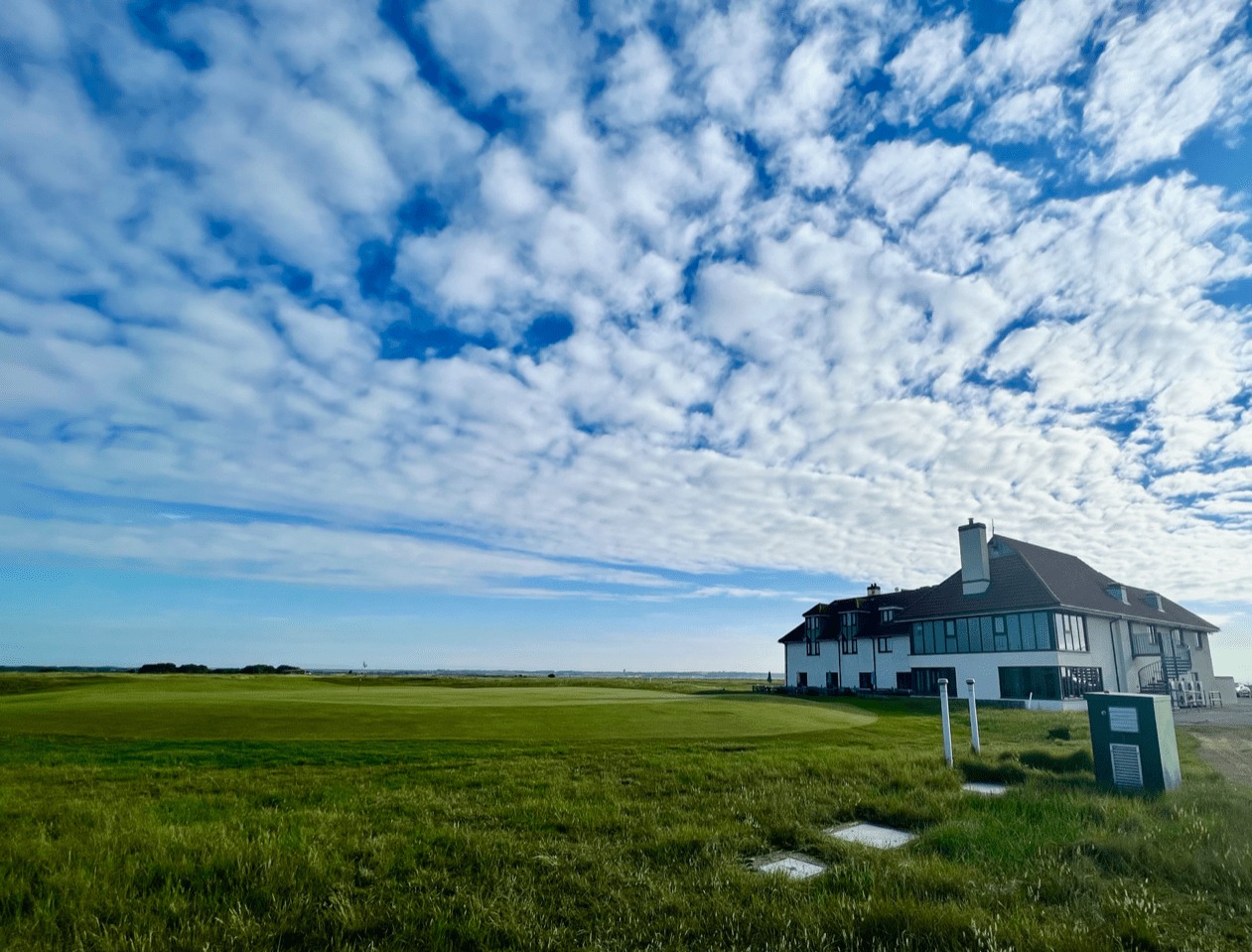
It is only a stone’s throw to the coast. Here, the three-star Lodge at Prince’s Golf Club awaits us, where we are greeted with a very warm welcome and spend the next four days. Situated at the entrance to the golf course, it has 34 double rooms and two suites. Our spacious, bright Bay Suite offers plenty of room and a great view through the floor-to-ceiling window of Sandwich Bay, which is within in easy reach.

The Lodge at Prince’s Golf Club an der Sandwich Bay (Foto: Jürgen Linnenbürger)
The Lodge at Prince’s Golf Club at Sandwich Bay (Photo Juergen Linnenbuerger)

We enjoy breakfast in the Lodge’s Brasserie Restaurant as well as delicious fish and meat dishes for dinner and a nightcap in the cosy bar.

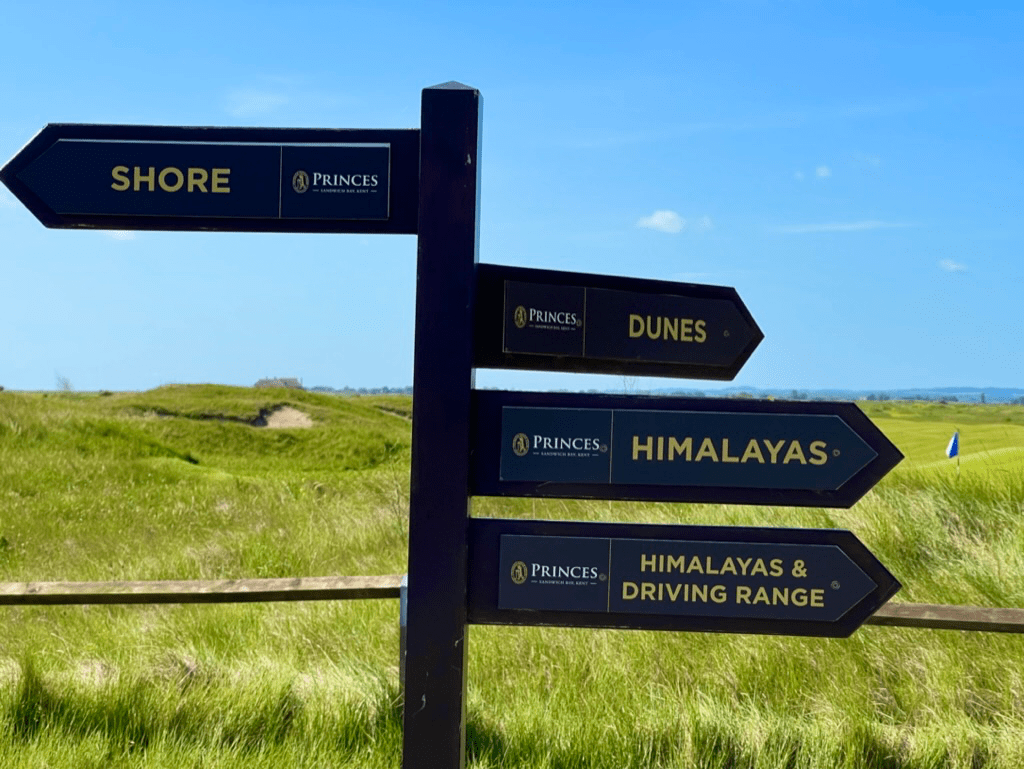
Himalayas, Dunes and Shore

The tradition-steeped club was officially opened in 1907 as an 18-hole course. After World War II, it was expanded to 27 holes in 1950. From The Lodge it is a short drive to the clubhouse where  the three loops start and end.

27 beeindruckende Löcher des Prince’s Golf Club (Foto: Jürgen Linnenbürger)
27 impressive holes (Photo Juergen Linnenbuerger)

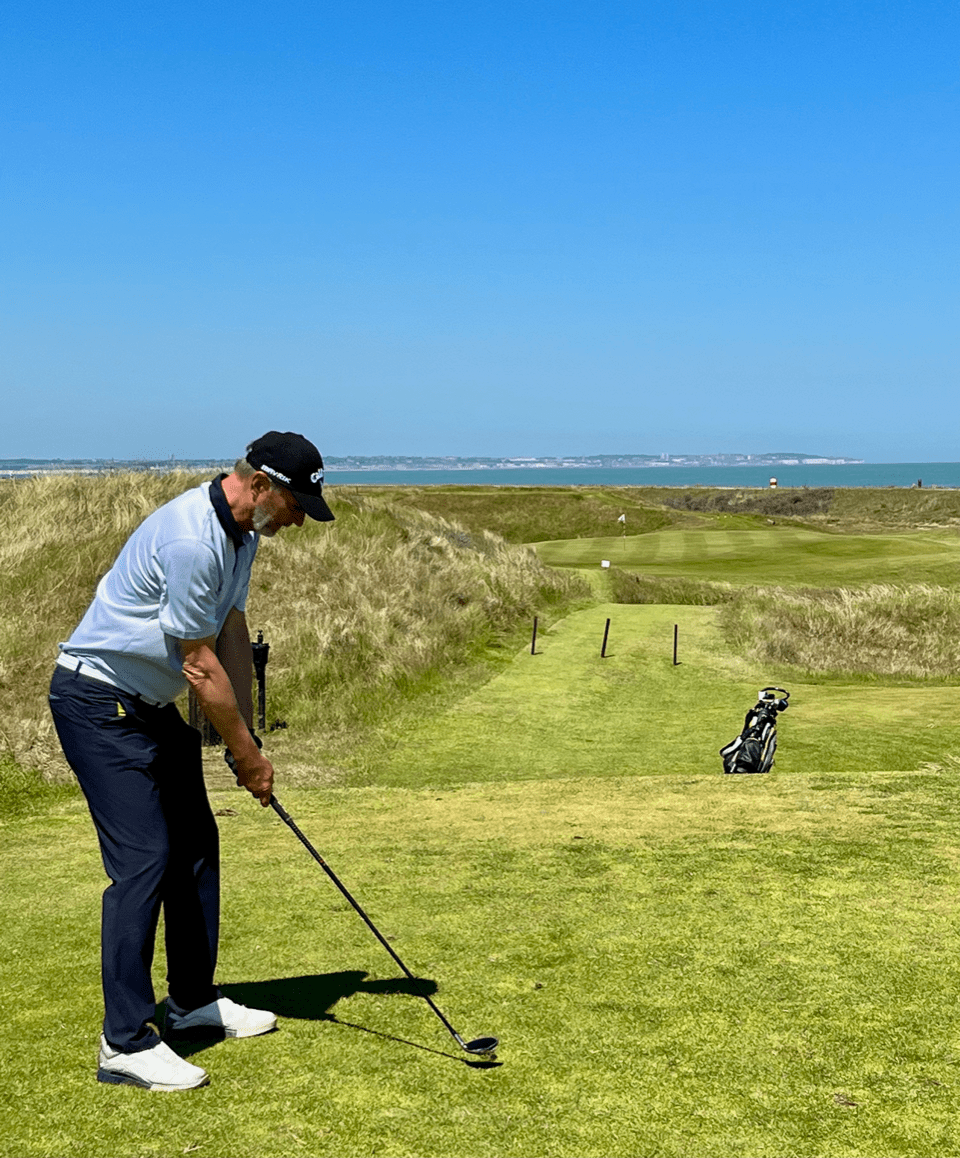
We encounter true links golf at its finest; a layout of impeccable quality with rolling fairways, deep rough, elevated tees, huge greens with incredible roll-out zones, large waste areas and a whopping 97 bunkers.

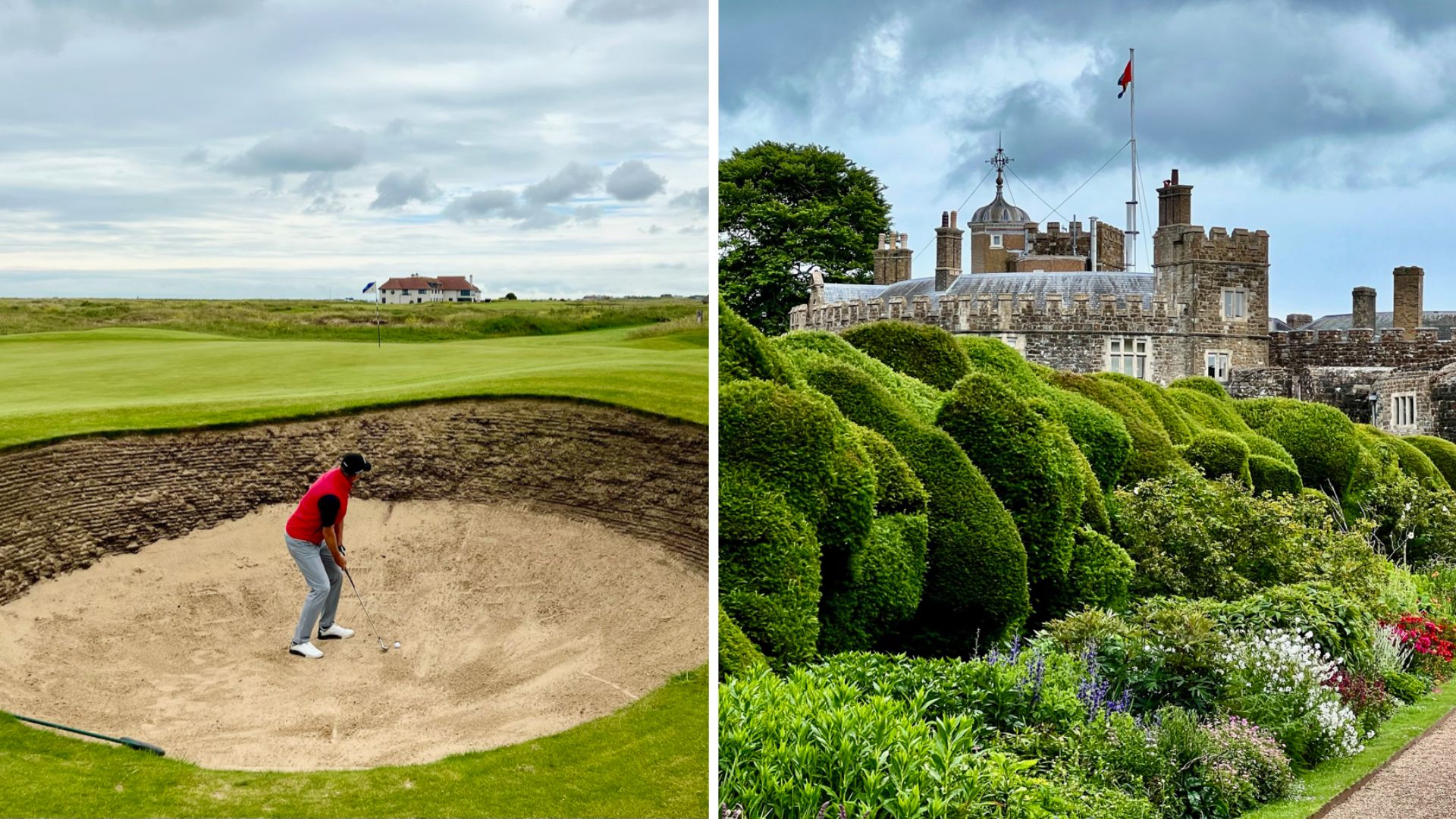
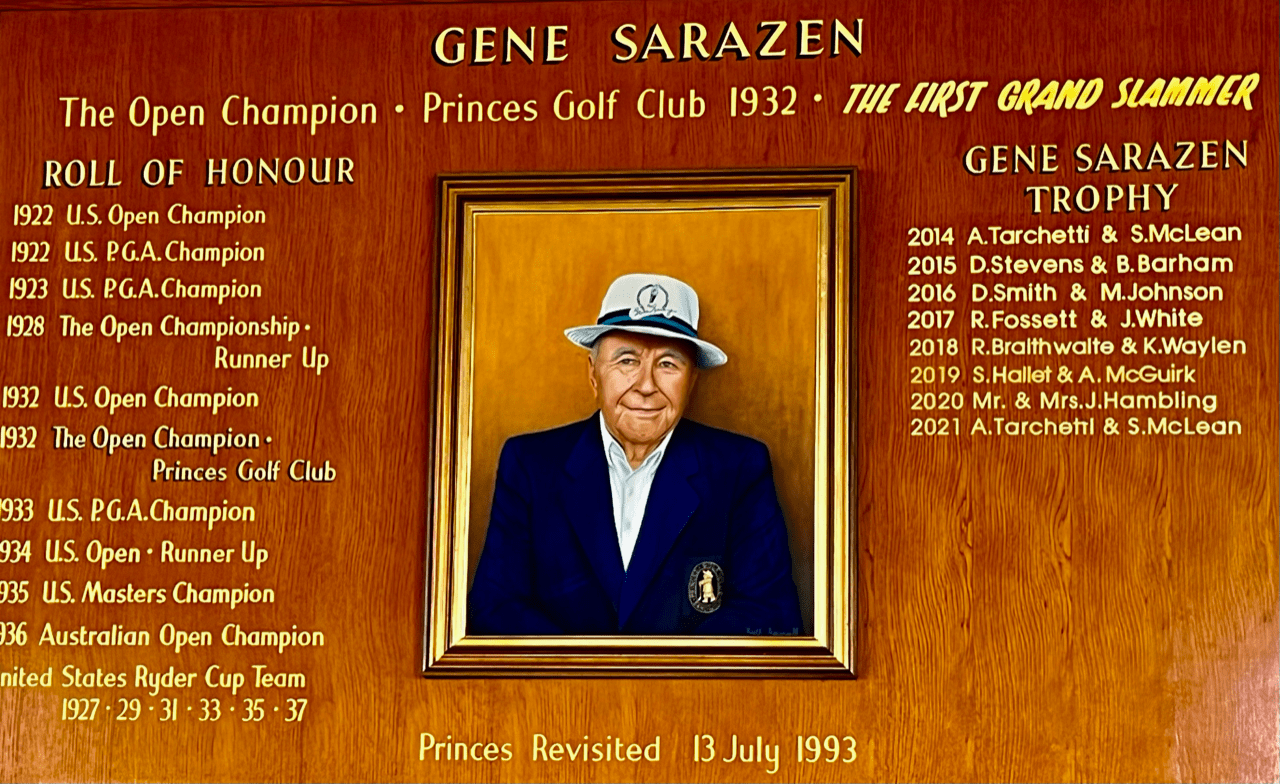
Its most famous is named after the legendary American Gene Sarazen, who in 1932, won the only Open Championship ever held here and was the first player to win all four majors. In that tournament, he used the sand wedge, which he invented, for the first time.

Ehrentafel im Clubhaus des Prince’s Golf Club (Foto: Jürgen Linnenbürger)
Honours Board in the Prince’s clubhouse (Photo Juergen Linnenbuerger)

The bunker protects the green of the final hole of the Himalayas loop, which was redesigned into a modern links by the golf architectural firm Mackenzie & Ebert in 2018.

The Saranzen bunker on the 9th of the Himalayas (Photo Prince’s Golf Club)

The spectacular Dunes and Shore loops have also undergone redesigns in recent years. They form the Championship Course, which is one of the top one hundred 18-hole courses in Great Britain and Ireland.

In addition to numerous high-ranking amateur and professional tournaments, the Final Qualifying was played on this course for the fourth time in a row. This is where the last few places were awarded for The Open Championship, which just celebrated its 150th anniversary in 2022 at St Andrews in Scotland.

We encounter a friendly, relaxed sporting atmosphere and warm hospitality throughout the club.

Attractive stay, play and dine packages perfectly round off this great offering.

More great impressions at:

https://www.princesgolfclub.co.uk

A perfect deal

We play our next round at the Royal Cinque Ports Golf Club in the coastal town of Deal. It is located only six kilometres from Prince’s on a narrow piece of former farmland. Deal, as it is also called, is one of the most recognised courses in the country. The Private Members Club, founded in 1892, also boasts a rich tradition. Here, too, we receive an extremely friendly welcome.

The Open was held here twice, in 1909 and 1920. More were planned, but due to the World Wars and flooding of the course several scheduled were cancelled.

Running directly alongside the sea, the front nine leads away from the clubhouse one after the other, the back nine just as straight and parallel back to it.

Par 3 direkt vor dem English Chalet ( Foto: Jürgen Linnenbürger)
Tee shot with an amazing backdrop ( Photo Juergen Linnenbuerger)

The fairways are short mown, hard as a board and not very wide. They roll through the open terrain with sandy waste areas making the round a breathtaking rollercoaster ride; constantly uphill and downhill. Sloping terrain is the rule whilst the rough is just as merciless as the countless deep pot bunkers.

The greens are extremely undulating, surrounded by huge run-off areas, furiously fast and almost impossible to read.


Hit and hope – incredible greens with perfect conditions (Photo Juergen Linnenbuerger

In addition, there are numerous blind tee shots. All this makes the round a real test of golf, especially when the wind blows from the sea. Then the last seven holes are supposed to be brutally difficult but we are spared this experience because we catch a sunny and almost windless day, which is extremely rare here.

Gary Player describes the last four holes with: “I consider the last four holes at Deal to be without doubt, the finest four consecutive holes on any course in the world.” No wonder, then, that the course is currently ranked 12th in England and among the best 100 in the world.

Holes 16 and 17 (Photo Royal Cinque Ports Golf Club)

We enjoy the authentic links golf and are thrilled with the course all around; its layout and maintenance are world class.

The winners of professional and amateur tournaments held here adorn the numerous Honours Boards in the clubhouse dating back to the founding year. These include the annual The Halford Hewitt Cup, in which 10 players from each of 64 English public schools compete against each other. 

On the clubhouse terrace we enjoy a pint and the great view over the course.

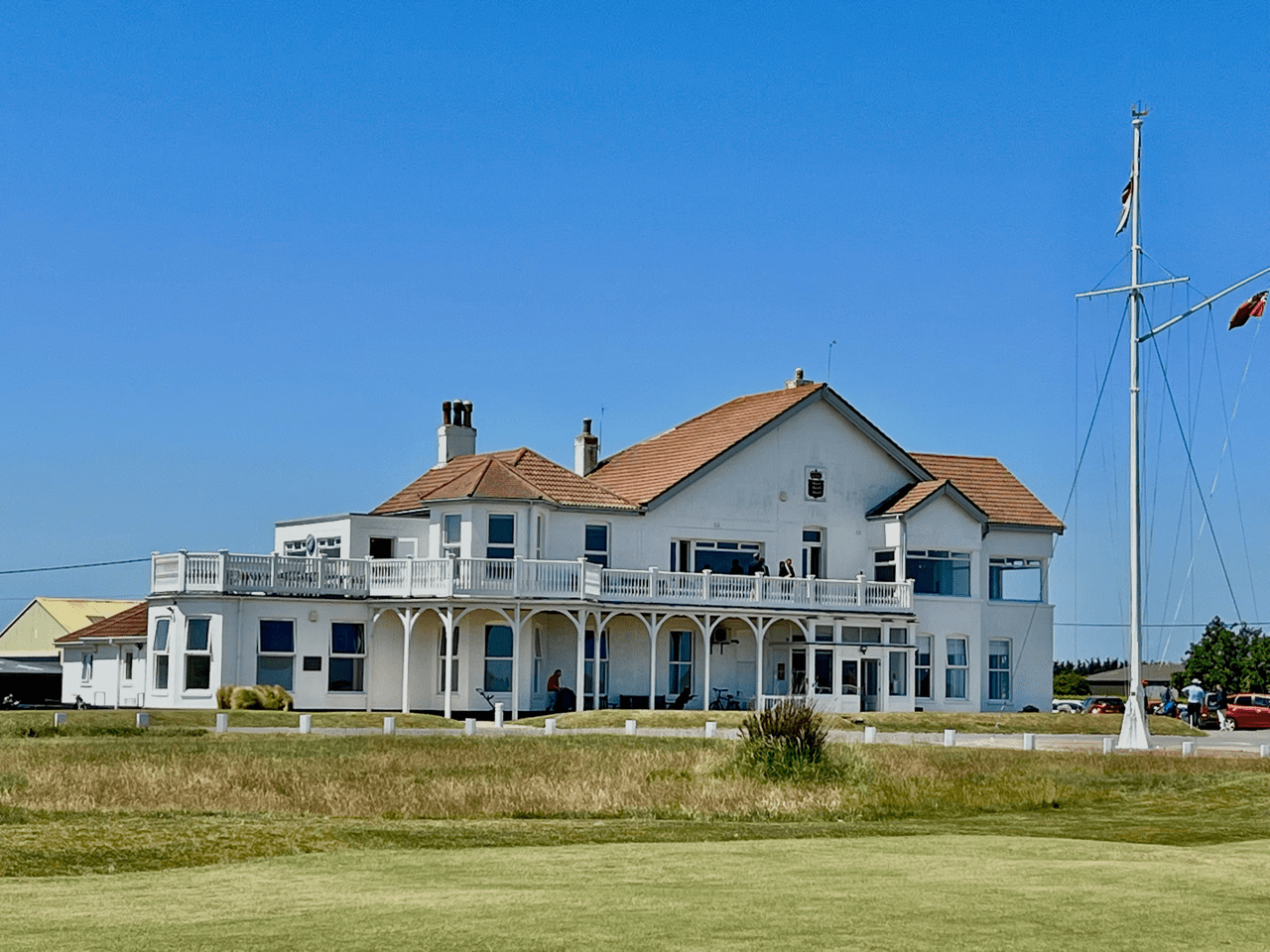
Ursprung im Jahr 1892 - Clubhaus mit Stil und Tradition (Foto: Jürgen Linnenbürger)
Origin in 1892 (Photo Juergen Linnenbuerger)

The official club video whets further appetite:
https://www.royalcinqueports.com/club/film/

In my recently released article “The cream of the crop” I report on the third coastal course we played, the Royal St. George’s Golf Club, which is considered the number one course in England. In it I describe, among other things, what its unique ‘Coffin’ bunker means.

Back to the Middle Ages 

The venerable Canterbury is a university city and an episcopal see. The beginning of its imposing cathedral with its 75 m high tower dates back to 597, when Pope Gregory I sent a monk to Canterbury to build a ‘cathedra’ (seat) here. Today it is the headquarters of the Anglican Communion, the Church of England. The murder of Archbishop Thomas Becket in 1170 made it one of Europe’s most famous pilgrimage sites. A lit candle in the cathedral commemorates the site of this assassination.

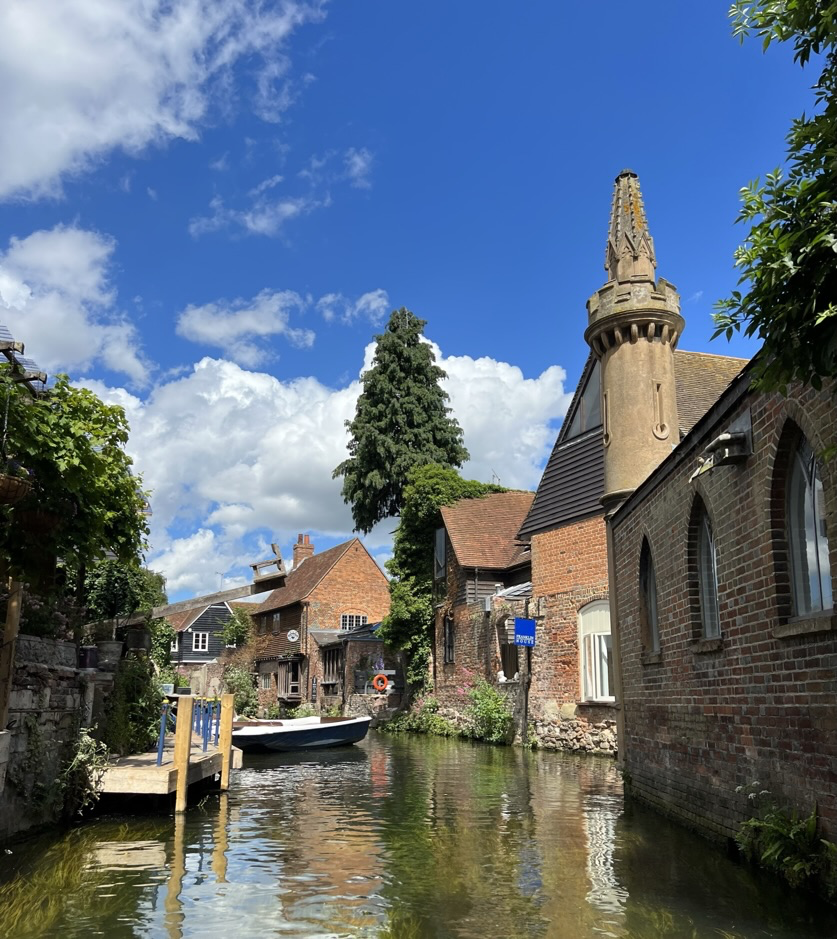
We also like the pretty medieval streets with their small shops, restaurants and pubs, as well as the raft trip across the Stour, supposedly the cleanest river in England.

Bootstour auf dem Fluss Stour im historischen Canterbury (Foto: Jürgen Linnenbürger)
Boat trip on the River Stour in historic Canterbury (Photo Juergen Linnenbuerger)

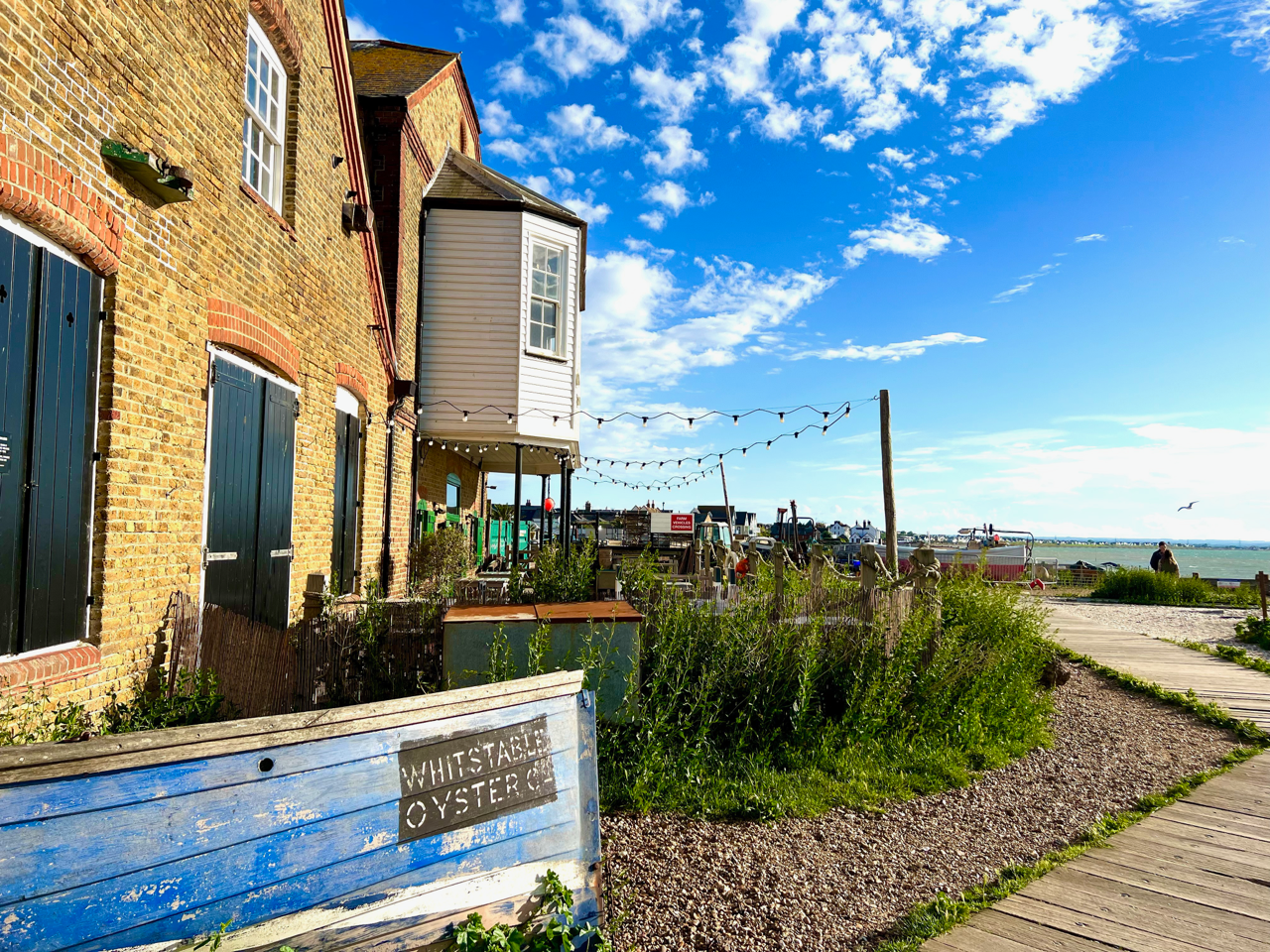
Also worthwhile from here is the short drive to the coastal towns of Margate, Broadstairs and Whitstable, the oyster centre on Kent’s north coast. Very delicious, what the sea brings to the plate here and a portion of the best fish ’n’ chips is a must, of course.

Seafood vom Feinsten in Whitstable (Foto: Jürgen Linnenbürger)
Seafood at its best in Whitstable (Photo Juergen Linnenbuerger)

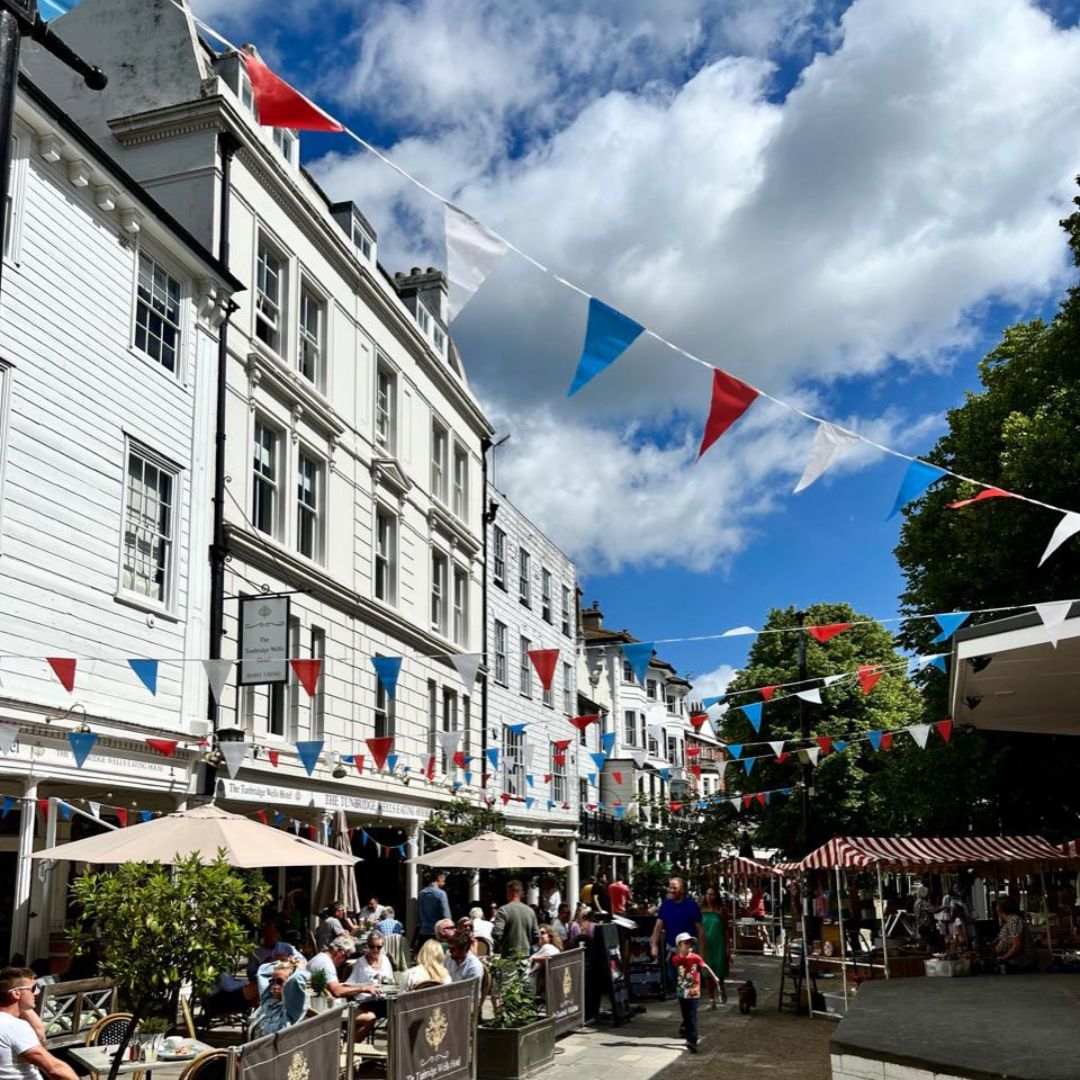
We continue west to Royal Tunbridge Wells. This picturesque spa town was already held in high esteem by Queen Victoria. The Pantiles, the oldest pedestrianised street in England, has its origins in the early 17th century and some houses dating from 1606 are still standing today. It captivates us with its white colonnades and transports us to another time.

Antikmarkt im wunderschönen Tunbridge Wells (Foto: Jürgen Linnenbürger)
Antique market in beautiful Tunbridge Wells (Photo Juergen Linnenbuerger)

Romantic gardens full of flowers

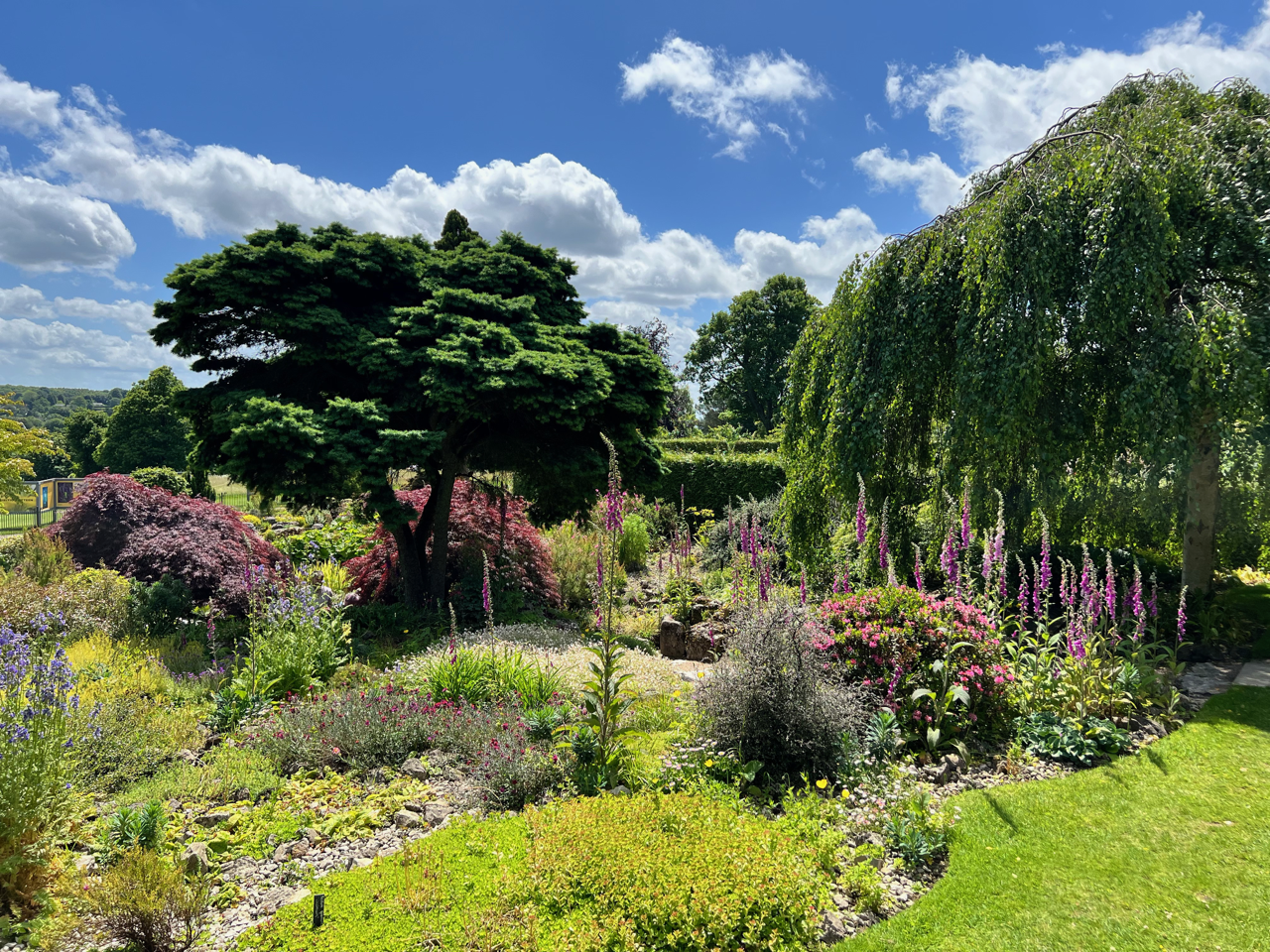
The most famous gardens in Kent are those of Sissinghurst Castle with its ten garden rooms. Not as crowded, but just as impressive, we find the Riverside Himalayas Garden and the Emmets Garden in Sevenoaks. Their variety and colourfulness are simply amazing.

Prachtvolle Anlagen im Emmets Garden in Sevenoaks (Foto: Jürgen Linnenbürger)
Magnificent grounds in Emmets Garden in Sevenoaks (Photo Juergen Linnenbuerger)

Oh my deer

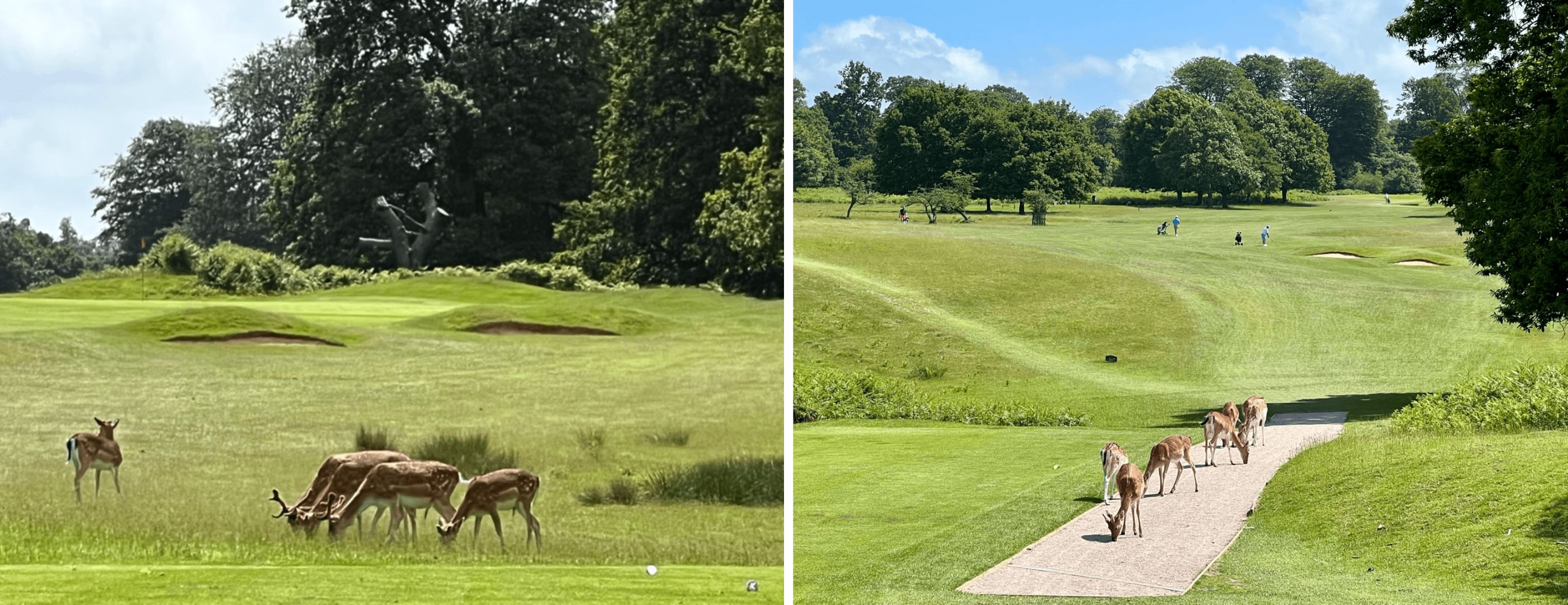
Right next door is Kent’s most beautiful inland course, which is one of the top 100 golf courses in England. Knole Park Golf Club is located in the 1,000 hectare public deer park of the same name. The club was founded in 1924 and designed by the architect J.F. Abercromby.

There are considerable differences in altitude to overcome on the hilly championship course, which is open to the public so pedestrians and joggers often cross the path.

Zahme Rehe im Knole Park Golf Club und die großzügig angelegten Fairways. (Foto: Jürgen Linnenbürger)
Tame deer at Knole Park Golf Club and generously laid out fairways at Knole Park Golf Club (Photo Juergen Linnenbuerger)

The spacious, open layout delights us as much as its state of maintenance. Each hole has its own identity and remains in the memory and the course is sportingly demanding, yet fair.

The 17th century Knole House towers in the background.

Knole House am Rande des Knole Park Golf Clubs (Foto: Jürgen Linnenbürger)
Knole House on the edge of Knole Park Golf Club (Photo Juergen Linnenbuerger)

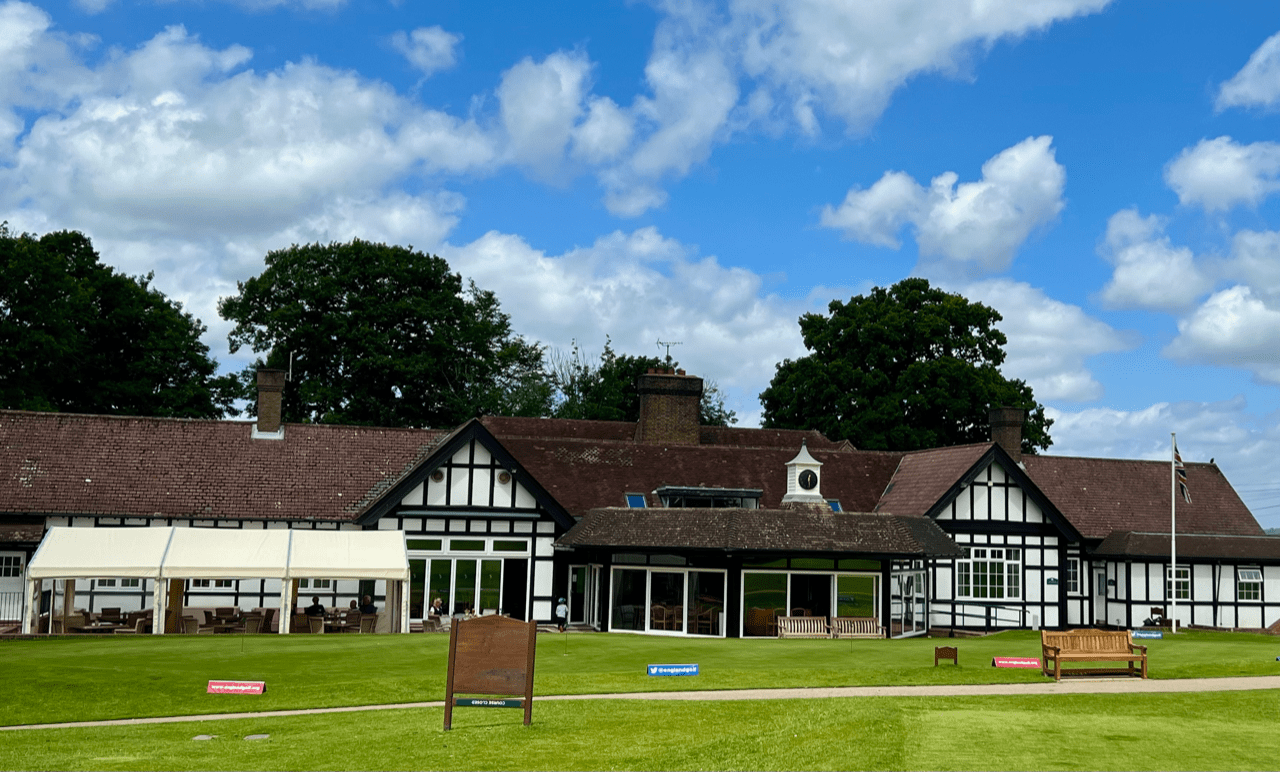
We receive a friendly welcome in the pro shop and the traditional clubhouse and are amazed by the Honours Boards with winners from about hundred years.

Clubhaus des Knole Park Golf Clubs (Foto: Jürgen Linnenbürger)
Traditional Clubhouse of Knole Park Golf Club (Photo Juergen Linnenbuerger)

A castle like in a picture book

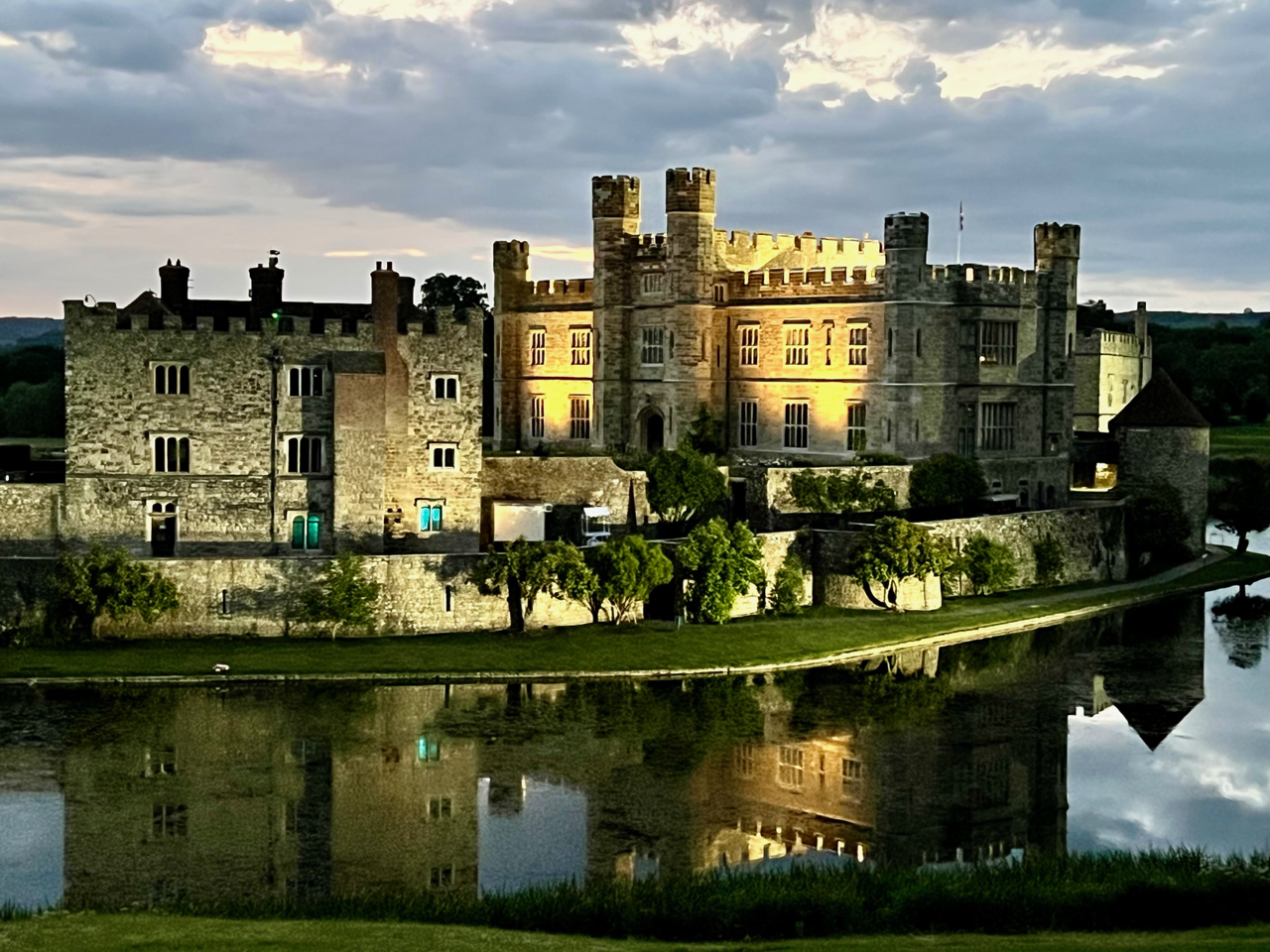
We spend the last two days of our round trip in the ‘most beautiful castle in the world’. At least, that’s how the moated Leeds Castle with its magnificent gardens advertises itself. It is located near the small town of Lenham near Maidstone in the middle of Kent. We are also captivated by it.

Built more than 900 years ago, it first became a royal residence in 1278, and several English queens lived here, including Catherine of Aragon, the first of the six wives of Henry VIII, which is why it is also called the castle of women. Since 1976, it has been owned by a private foundation and is open to the public.

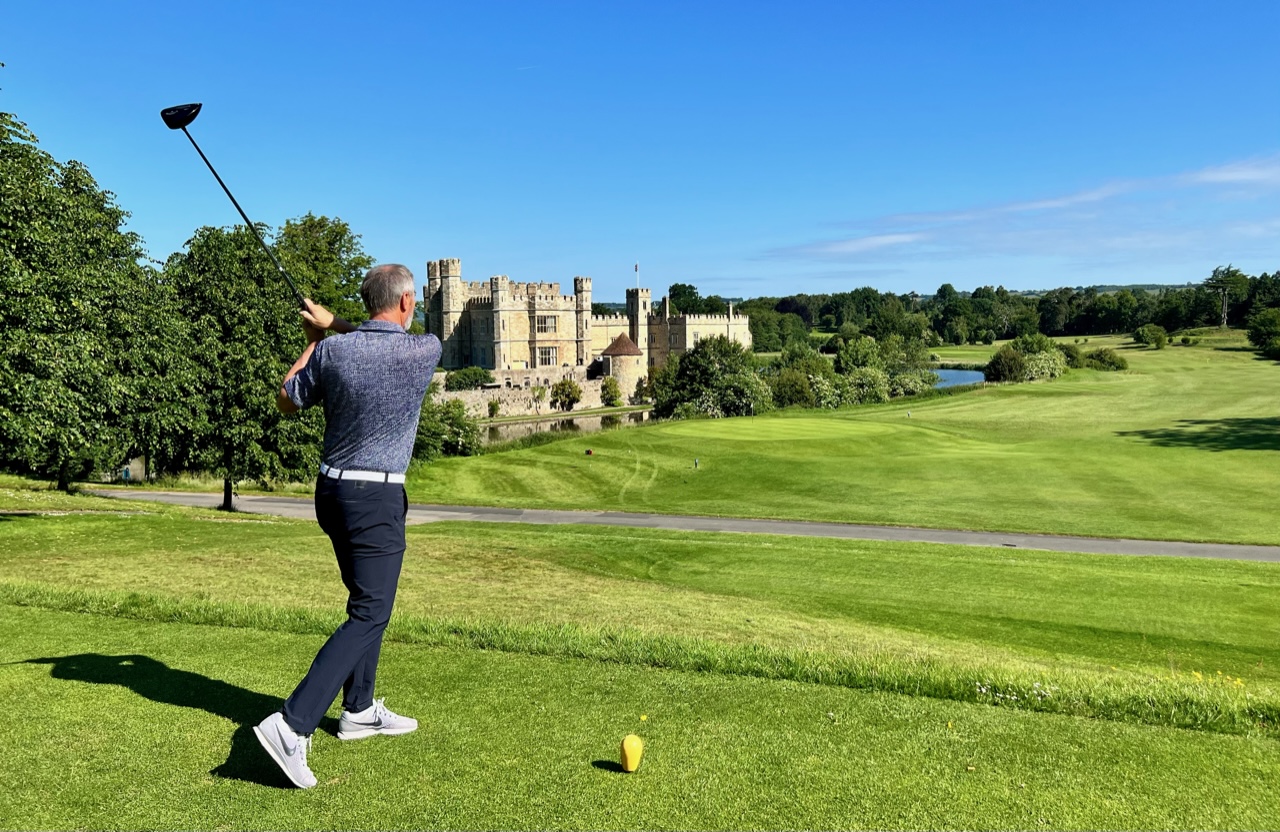
The round on the 9-hole course of the Leeds Castle Golf Club with great views of the castle grounds forms the sporting conclusion of our golf trip.

Nicht nur das Fairway im Blick (Foto: Jürgen Linnenbürger)
Not only the fairway in view (Photo Juergen Linnenbuerger)

The crowning finale is dinner in the Castle Restaurant with a view of the castle opposite. The end of our Kent trip to this beautiful part of England could not be more stylish.

Leeds Castle - einfach nur traumhaft schön (Foto: Jürgen Linnenbürger)
Leeds Castle – simply beautiful (Photo Juergen Linnenbuerger)

We will definitely be back to see the other great golf courses, dormy villages, castles and fruit, hop and wine growing that also characterise the county. Then we hope the weather will be as fantastic as it has been all the time during our visit. See you soon Kent.

Cologne, July 2022

Categories
Travel

The cream of the crop: Royal St. George’s Golf Club in England’s South East

The best of the best

In many rankings it is considered England’s number one. It is currently
ranked 22nd in the world, making it one of the most recognised on the
golfing globe. Tradition and style meet the highest quality and class.
Everything here is special.

Impressive history

Its beginning dates back to 1887, when it was founded by Dr William
Laidlaw Purves as England’s equivalent of St Andrew’s in Scotland. It is beautifully situated, right on Sandwich Bay on the shores of the English Channel.
In 1894, the first Open Championship outside Scotland took place here. In the meantime, this event, which is regarded as one of the world’s most important tournaments, has taken place 15 times at this location. Nowhere has it been held more often outside Scotland. The club last
hosted the tournament in 2021, the 149th time it has been held.
The list of notable professional and amateur competitions held here is
endless.

The board hanging in the clubhouse lists winners from three centuries
now. Darren Clarke in 2011 and Collin Morikawa in 2021 were the last two winners to take possession of the coveted Claret Jug trophy in Kent.
The sensational layout of the course owes much to several notable
architects. In addition to the founder mentioned above, they include
Allister McKenzie and Frank Penning.

A perfect routing of 18 impressive holes (Photo RSG/Jason Livy)

Style and Etiquette

The club is a Private Members Club, but opens its doors to non-members on certain days at certain times. Guests are welcome and will receive a warm welcome. However, some rules apply to them, as published on the club’s website.
They may sound antiquated, but from my point of view they fit perfectly with the tradition, to which a lot of importance is still attached. Nothing is modern here, but everything is dignified and noble. Old school golf at its best.
This includes, among other things, that golf clothing may only be worn in the clubhouse until 11.00 am. After that, gentlemen wear a jacket and tie, ladies an appropriate outfit although on the terrace and in the snack bar, golfing outfits are accepted all day.
If gentlemen opt for shorts, they are to be worn with knee-high socks with members often wearing red and green striped club socks. Golf shoes and caps, as well as wet weather golf clothing, are taboo in the clubhouse.
Guests are requested not to change in the car park, but in the locker
rooms, which are furnished with fine wood. Mobile phones are frowned upon on the course and in the clubhouse but fine to use whilst in the car park.

Originally, it was planned to have lunch before our round in the famous dining room of the venerable clubhouse. However, this reservation was cancelled at short notice, as on the day of our visit about 300 members had gathered there to commemorate the life of a recently-deceased former President. So the sacred halls remain inaccessible to us. Instead, we spend some time on the al fresco terrace overlooking beautiful gardens.

Snack on the terrace where coffee and water are free of charge (Photo Juergen Linnenbuerger)

More tension is impossible

While changing, I clearly notice how my excitement slowly increases. Then it’s off to the course as my adrenaline level continues to rise and my heart races. I try to block out who has teed off at this spot since 1887 and concentrate on my first tee-shot. St George’s is a 2ball course except on Tuesdays which is when the majority of visitors usually play as 3balls or 4balls.

Tee-off every eight minutes (Photo Juergen Linnenbuerger)

Unfortunately, the initial sunshine leaves us and the cloud cover increases considerably, but it stays dry and the usual strong wind stays within limits.

Huts at the first tee ( Photo Juergen Linnenbuerger)

Then it starts. I take a deep breath and try to block out everything else. Richard, our caddie, recommends me to play an easy draw. Nothing easier than that.

Caddies are an indispensable help (Photo Juergen Linnenbuerger)

‘Well done’ Richard comments on my tee shot. Then we race off as
leisurely golfing is not the order of the day here. Anyone who needs more than 3 1/2 hours for the 18 holes as a 2ball is out of place.

Perfect conditions throughout the course

The par 70 course has a length of 7,204 yards from the championship
tees. Unlike most classic links courses, the front nine does not run away from the clubhouse and the back nine back to it. Instead, the holes are laid out in more of a big loop, so you don’t play one hole into the same direction. This means having to readjust to the usual wind on each hole.
On eight of them you play directly along the Channel.

The natural beauty speaks for itself (Photo Juergen Linnenbuerger)

Even the tee boxes stand out because of their perfect condition. Other
clubs would be happy to have greens like this. This impression continues seamlessly on the course. The very undulating fairways are mown extremely short. I hardly dare to hit a divot.
The balls roll without end. They don’t always go where they’re supposed to, but they make length. Even if I think I’ve hit the middle of the fairway, that doesn’t mean the ball will come to rest there, but Richard, who seems to have eagle eyes, helps.

The views of the Channel are magnificent. The naturalness of the course cannot be surpassed. Nothing here has been artificially created, but everything has been left in its original look and feel. The dunes are huge and sometimes severely restrict the view of the fairways. These blind tee shots require confidence and self-assurance.
The dune grass sways in the not too strong wind. After last week’s rain
and the subsequent sunshine, it has literally exploded. It looks more
harmless than it is. Getting out of the dense rough is almost impossible.

The sportiest possible challenge

After only a short time, we realise that the HCP limit of 18.4 is completely justified. If we stay in the game, greens await us that we have not yet experienced in this form. Where and how should the ball come to rest on the partly huge, inverted saucers?

Professional reading help is worth its weight in gold (Photo Juergen Linnenbuerger)

They are ondulated, furiously fast and surrounded by huge run-off areas. Two putts are a great result, but we only manage this if we hit the greens perfectly. And that doesn’t happen too often. The white flags bear the red cross of the patron Saint George. We need his help.
And then there are the bunkers – the regular and the pot bunkers. They are as pristine as you would expect on a true links course.
The highlight is the one at the four. Until recently, it was still supported by 93 railway sleepers on the sides though these were recently removed for safety reasons. This blind tee shot must be played uphill over a dune.

The sleeping giant (Photo Royal St. George’s GC/Jason Livy )

After about 150 metres, lies the deepest and steepest bunker in the entire United Kingdom. Richard tells us that it is also called ‘coffin’: once you are in it, you never get out again! I am the best example, as the photo proves. After three unsuccessful attempts, I buried the score on this hole.

The monster cut into the dunes (Photo Juergen Linnenbuerger)

It is the second most difficult hole of the 18 exciting holes, which are all different and have their own names. This one is unsurprisingly called The Himalayas whilst other well known ones are called The Maiden, Sahara and Suez Canal.
Each hole has its own great charm and remains memorable for us. The
front nine should allow for the better score, as the back nine is even more challenging. The lengths are brutal for average HCPers, especially when the wind comes into play. This kicks in on the back nine and makes the last holes a special test for us.

Drinking water is available at various points on the course, even for four-legged friends. Only toilets we look for in vain. Richard thinks we should use mother nature.

Fresh water for everyone (Photo Juergen Linnenbuerger)

After 18 holes we are exhausted: mentally and physically. But richer by an experience that is one of the most extraordinary we have ever had on a golf course. Golf at its purest. This alone counts. The result is absolutely secondary.

Happy and satisfied on the tee of the 18th hole (Photo Juergen Linnenbuerger)

We politely thank Richard for his great job, pay him the usual fee of GBP 50,- and give him the well-deserved tip. This was already because of the balls he found again in the deep rough. So our loss was absolutely manageable.
We will keep every moment of this unforgettable day on one of the world’s most impressive golf courses in best memory.
Cologne, June 2022
Juergen Linnenbuerger

Categories
Travel

A Colt-play Gala in the heart of the Netherlands

Travel insider Jürgen Linnenbürger takes a day trip to Utrecht, the capital of the smallest province of the same name, and gets to know the Utrechtse Golf Club de Pan, one of the leading golf courses in continental Europe.

Part of the Oude Negen


Every time I get to know another top course of our western neighbours, I am thrilled all over again. The number of exceptional golf courses is simply impressive. Those that belong to the group of the Oude Negen (Old Nine) are particularly appealing to me. This includes the course I am presenting today, where I encounter traditional old school golf at its finest.

Leading in the Netherlands and Europe

We have been looking forward a long time to play the Utrechtse de Pan golf course, which currently ranked second in the Netherlands. The club is equally proud of the fact that it also enjoys the highest international recognition. Not only does it rank among the top 3 in continental Europe,
but it is also represented in the top 100 of the world’s best courses. Three Dutch Opens have been held here. The last time, however, was in 1984.

It is the second oldest golf club in the Netherlands. The club’s origins date back to 1894, when it was founded as the Doornsche Golfclub with a nine-hole course. In 1927 the club moved to its present site, was renamed Utrechtse Golf Club de Pan and opened as an 18-hole course in 1932.

Its original design is due to the great Harry S. Colt, who also took on the design of several other top courses in the Netherlands in the early 20th century. The Englishman designed De Pan in 1929.

In the years that followed, some changes were made. In the last decade, however, these were gradually dismantled by the renowned golf course architect Frank Pont, so that the course is now almost back to its original state.
Guests are welcome to join the private Family Members Club on certain days. To get to know and appreciate the traditional setting on the historic grounds, a minimum HCP of 24 is required.
The club is not easy to find. You quickly drive past the small entrance sign. From the car park, a short path leads to the beautiful thatched clubhouse that crosses the 10th hole. Those standing at its elevated tee operate a switch that triggers a flashing light to warn people passing by.

In front of the clubhouse, we are greeted by the bronze statue of the Greek shepherd god Pan, gleaming in the sun, which was donated by members in 1994 on the occasion of the club’s 100th anniversary. He is said to haunt the Forest de Pan and trigger the famous pan-ic attacks in the
players. Fortunately, he spared us on our round.

The shepherd god Pan at the entrance to the course (Photo: Jürgen Linnenbürger) 

We are warmly welcomed by Siemon, a member of the Course Committee. In the traditional and cosy clubhouse, he gives us background information about the club and the course. We learn that great importance is attached to environmental protection and that the club has decided, among other things, to use a maximum of 30,000 cubic metres of water per year to irrigate the course. Usually, however, only 12,000 – 14,000 are used. Only in the extremely dry year of 2018 24,000 cubic metres were needed.
We are greeted just as nicely by the friendly caddie master John, who kindly lets us onto the round.

Friendly welcome in the cosy clubhouse (Photo Jürgen Linnenbürger)

Complete tranquility in unspoilt nature

The slightly hilly, classic heathland course is located in the middle of the majestic de Pan forest. It is considered one of the most beautiful in the Netherlands. Its 18 holes are perfectly integrated into the peaceful nature. The masterful routing through the not too large terrain is exceptional and among the best created by Harry Colt. It is very pleasant that they and the tees are extremely close to each other and are only separated by short distances. Some tees are played from elevated tee boxes.

Tee times are spaced at a comfortable distance, so you’re alone on most holes and can’t see the rest.

If you’re lucky, you’ll see deer or foxes on the fairways, which are often intersected by the overgrown sand hills of the dunes, constantly coming into play as natural obstacles.

The fairways, which are not too wide, are lined with tall, old trees and roll over the sandy ground with a short mow. There are no water hazards here as well as not too many fairway bunkers. Greens come in all sizes. The perfect condition and the speed distinguish them all.

Precision before distance


The par 72 course has a length of 6,097 metres from the championship tees. There are a total of four different tee boxes, so that every HCP class has its own comparable challenge. From yellow it plays 5,716 metres, from red 4,935 metres long with an SR of 135 and 136 respectively.
Anyone who enjoys strategic play is in the right place here. It is not primarily distance that counts, but tactics and precision and the choice of the right club. Every single shot is a new challenge.
The varied round begins with a relatively short par 5, followed by a challenging par 4, whose attractive positioning of the bunker is already the first spoiler for many.

Inviting par 5 to start the round (Photo: Jürgen Linnenbürger )

After that, the first of four great par 3 awaits, to be played slightly downhill over the heath field through the aisle.

Hole Three: A par 3 with a length of 153 m from Yellow (Photo: Jürgen Linnenbürger)

From the sixth, the course really turns on. From here to the end of the round, it becomes clear why it is one of the best in the world of the golden age of golf architecture.

Hole six (HCP 1): Two blind shots and 391 m into the green (Photo Jürgen Linnenbürger)

Here, not only the tee shot is to be played blindly, but also the following approach into the green. The sign high in a tree is supposed to give orientation for the second shot. With luck, you will hit the green.
‚Belling‘ is highly encouraged. Already at the tee box of the sixth, you are kindly asked to inform the following group with three strokes on a bell when you have passed the knoll and that the fairway is clear.

‘Bellen’ is expressly desired (Photo: Jürgen Linnenbürger)

The tenth tee shot is played from the elevated tee carry over the aforementioned path and the long heather field.

Beautiful, but not for the faint-hearted – tee-off hole 10 (Photo: Jürgen Linnenbürger)

I manage a perfect drive to the point where the fairway narrows considerably on both sides due to the dune. From here it’s just a wedge into the green surrounded by imposing trees.

Approach into the well-protected green of the ten (Photo: Jürgen Linnenbürger)

The last three holes are then a bit more relaxed to play, as the course opens up wide from the 16th and the wide fairways allow for a good score.

A few steps lead up to the tee box on the 17th, where you have a great view over the heather field.

Hole 17: also a visual highlight – through the heath onto the elevated green (Photo: Jürgen Linnenbürger) 

The finish on this fantastic golf course is a par 5. If the long hitters stay in play after the tee shot, they have the chance to reach the green with the second shot.

Straight back to the clubhouse (Photo: Jürgen Linnenbürger)

I don’t succeed, but I am happy about my par, which concludes an unforgettable round on a fan- tastically designed and well-maintained golf course. The trip to our neighbours has been worth it once again. We start our journey home very satisfied and with a distinct feeling of happiness.
Further impressions of this exceptional course can be found in the official club video at: https://ugc-depan.nl/en.

Text: Jürgen Linnenbürger