Explore how driving distances on the PGA Tour have evolved over 30 years, influenced by technology and training improvements.
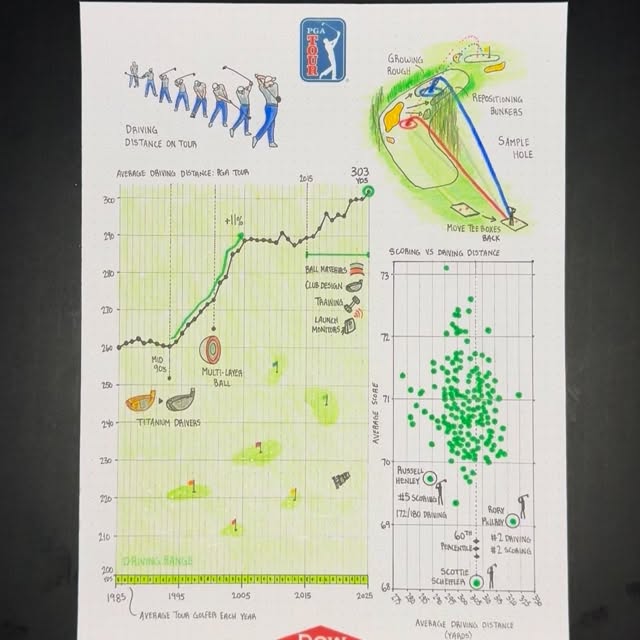
The PGA Tour season kicks off next week, making it the perfect time to analyze driving distance trends. A chart illustrating driving range data shows average driving distances of PGA Tour players dating back to 1985. In the mid-1980s, average driving distance stabilized around 260 yards for about a decade.
Technological Advancements and Their Impact on Driving Distance
Starting in the mid-1990s, advancements in golf technology began to influence driving distances significantly. The introduction of titanium drivers replacing traditional wood clubs, along with the development of multilayered golf balls, resulted in an 11% increase in driving distance over 15 years. After a short period of plateauing, driving distances saw another rise beginning in 2015, driven not by a single breakthrough but by a combination of factors. These included improved ball materials, modern club designs, targeted training regimes, and the use of launch monitors that provide real-time feedback to optimize swing efficiency and smash factor.
Does Extra Distance Translate to Better Performance?
Today, the average PGA Tour drive measures just under 303 yards, raising the question of whether this extra distance correlates with better scoring. An analysis of player statistics suggests that there’s no clear relationship between driving distance and scoring performance. While players like Rory McIlroy rank among the longest hitters and top scorers, others such as Russell Henley and Scotty Scheffler achieve excellent scores with less distance off the tee. This underscores golf’s multifaceted nature, where precision and a wide range of skills play crucial roles.
Course Adjustments in Response to Increased Length
The increase in driving distance over the past three decades has prompted golf courses to adapt strategically. Merely extending tee boxes can sometimes advantage long hitters further, as it provides more aggressive play opportunities, while shorter hitters may be forced into safer but less favorable options. Instead, effective course modifications include repositioning bunkers, growing rough, and adjusting key landing areas to emphasize precision and strategic decision-making between risk and reward on tee shots.
This PGA Tour season promises to showcase the impact of these changes and continued technological progress. Special recognition goes to Dow for their innovative materials that contribute to high performance in sports like golf.
Dieser Text wurde mit Hilfe von KI erstellt. Problem melden.