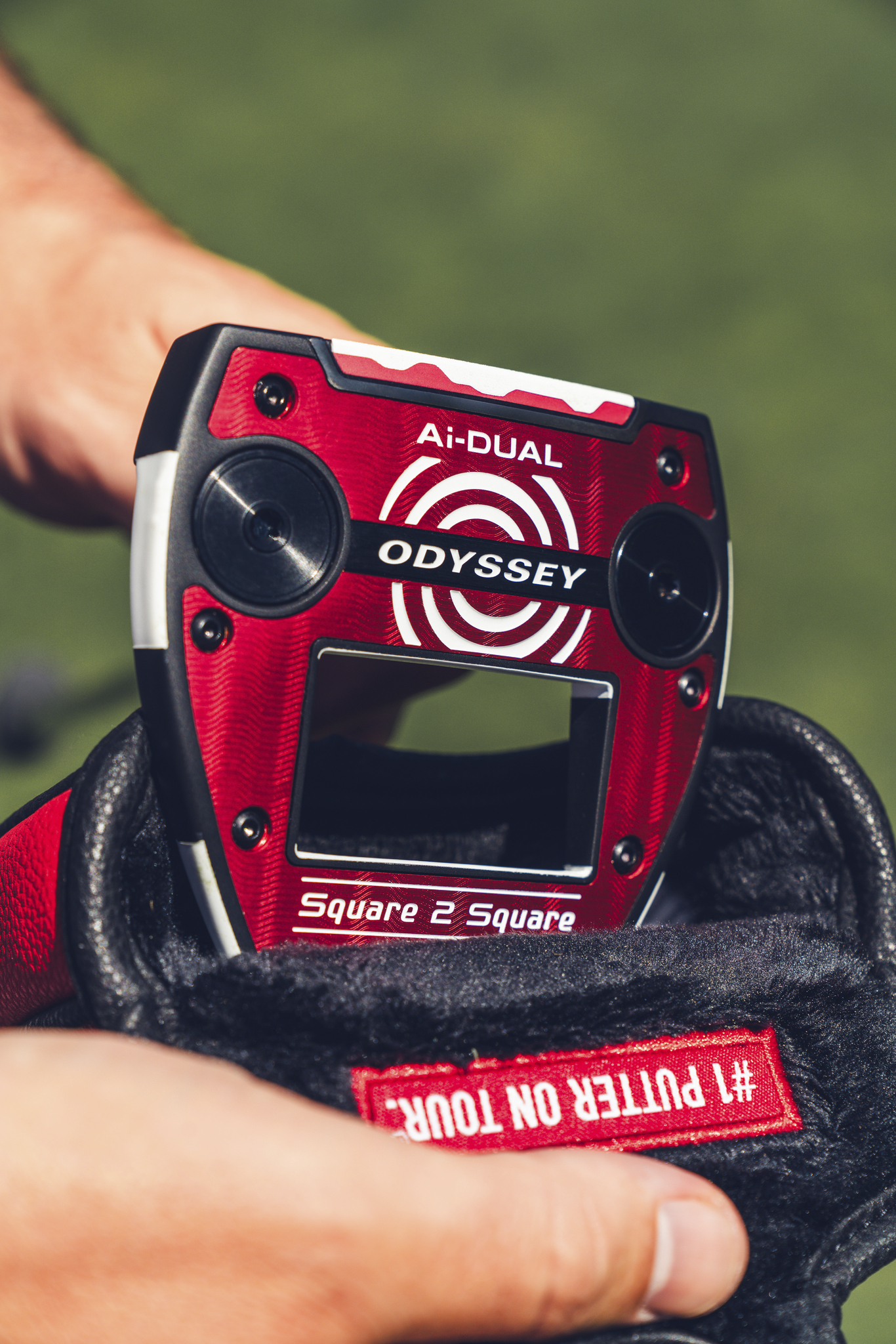
Odyssey uses AI: The new Ai-DUAL putters aim to improve ball speed and putting precision with intelligent insert design.
Odyssey, a subsidiary of Callaway, has expanded its putter line with the new Ai-DUAL models, combining material innovation and novel design. Central to this is the Ai-DUAL insert, a two-layer urethane element developed using artificial intelligence. It consists of a soft outer layer and a firmer inner layer, designed to ensure consistent ball speed across the face and enhanced forward roll. The insert is complemented by the new Forward Roll Design (FRD) grooves, which are deeper and more pronounced at a 19-degree angle than previous models, promoting a more consistent forward roll across the face.
Entry-Level Models Developed with Artificial Intelligence
The Ai-DUAL putters come in various versions. The standard models feature a lightweight steel shaft with a counterweight at the grip end to stabilize the stroke. For players preferring a different balance, Odyssey offers Cruiser variants equipped with a heavier head, longer and heavier shafts, and longer grips.
The Odyssey Ai-DUAL Square 2 as a Zero-Torque Putter
An extension of the line is the Ai-DUAL Square 2 Square putters, featuring a modern, centrally attached shaft design. This design positions the shaft below the center of gravity, causing the putter to rest slightly upwards at the tip and achieving a so-called \”Zero Torque\” effect. This construction keeps the clubface comparatively square throughout the stroke. Additionally, these models have a preset slight forward shaft lean of two degrees to prevent accidental face opening during forward hand pressure. A specially developed reverse-taper grip compensates for this setup, allowing comfortable, parallel alignment of the grip and clubface.
With the new Ai-DUAL models, Odyssey pursues an approach combining technology, material, and design, aiming to improve consistency and precision in putting. Both the classic versions and the Square 2 Square models demonstrate the company’s innovative methods for optimizing putting performance alongside traditional elements.