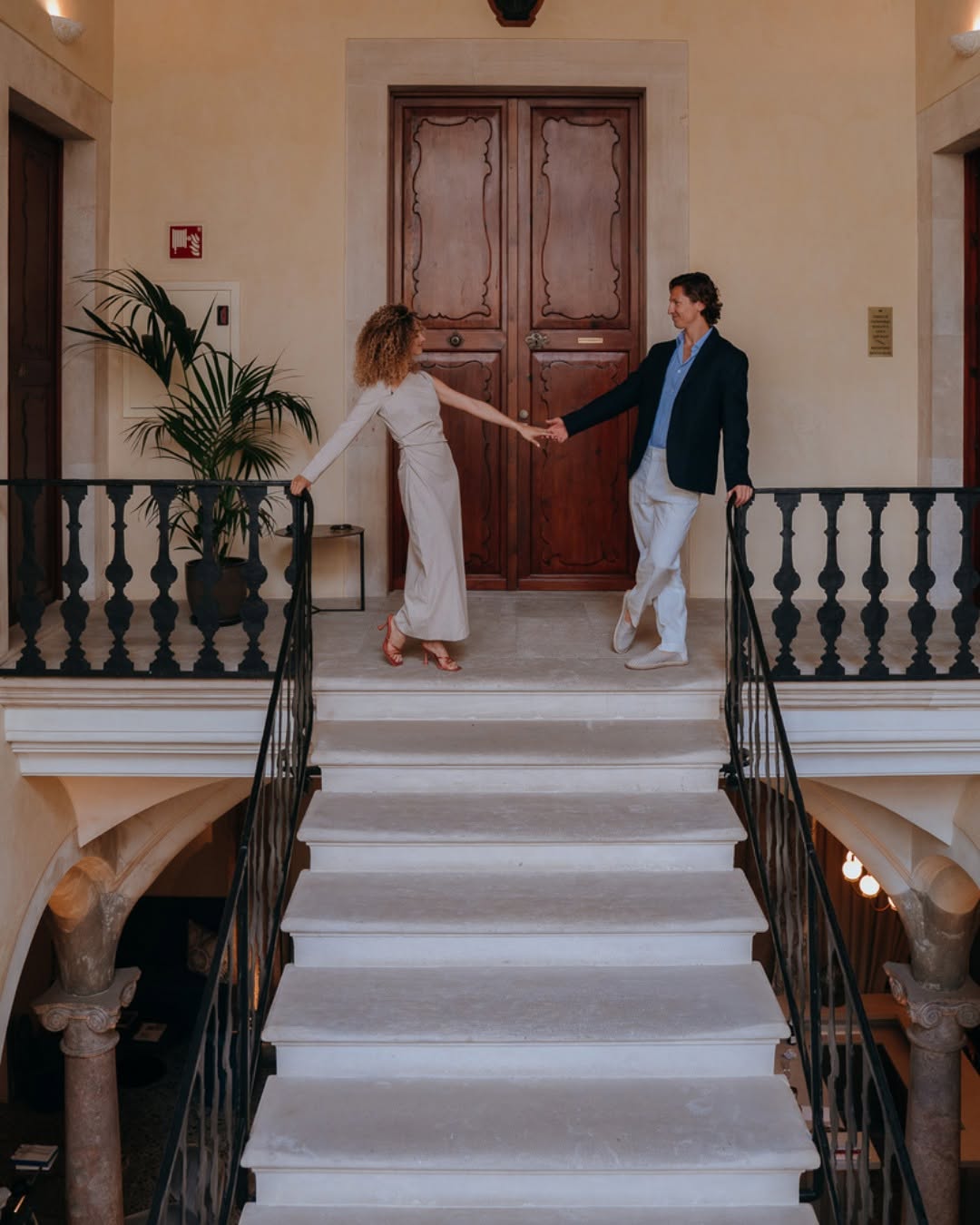
Every step reveals centuries of Mallorcan craftsmanship. Inside the island’s most refined palace hotel, marble and light compose a silent narrative.
There exists a particular species of beauty on Mallorca that resists easy description—the kind that announces itself not through grandeur alone, but through the deliberate language of materials and light. Palacio Can Marqués by Puro, nestled within Palma’s historic centre, embodies this understated sophistication most visibly in an element many guests might overlook: its monumental staircase.
When Architecture Becomes Storytelling
The palace’s principal staircase is far more than a functional passage between floors. It is, as the property’s curators describe it, a work of art in its own right—a statement that becomes immediately apparent upon ascending its first steps. The composition relies on three essential elements: marble, wrought iron, and the subtle orchestration of natural light filtering through skylights positioned overhead.
This triumvirate of materials speaks to the eighteenth-century origins of Palacio Can Marqués itself. The marble surfaces—likely sourced from Spanish quarries favoured by nobility of that era—carry the patina of centuries. They have been walked upon by merchants, administrators, and members of one of Mallorca’s most distinguished families. Unlike the sanitised marble of modern constructions, these surfaces bear the authentic wear of genuine history. The stone has softened slightly, its edges rounded by generations of footsteps, creating a subtle topography that modern fabrication cannot replicate.
The wrought iron railings continue this narrative of intentional craftsmanship. Forged by artisans whose names remain largely forgotten, these railings exhibit the baroque sensibilities common to palace architecture of the period. Their curves and flourishes serve not merely as safety measures but as sculptural elements—evidence of the painstaking labour that once defined luxury on the island.
The Choreography of Light in Palace Architecture
What distinguishes Palacio Can Marqués from countless other baroque and renaissance structures across Spain is its sophisticated relationship with natural light. The skylights positioned above the staircase do not simply illuminate; they actively shape the experience of moving through the space. As one ascends, the quality of light shifts throughout the day—cooler in morning hours, warmer as afternoon advances, eventually casting golden tones across the marble in late afternoon.
This is not accidental design. Eighteenth-century Mallorcan architects understood the island’s particular quality of light—its intensity, its seasonality, its ability to transform stone into something almost luminous. By positioning skylights with precision, they created an environment where time itself becomes visible. The shadow cast by a railing changes in length and darkness; the marble seems to breathe with the passage of hours.
Contemporary hospitality design often attempts to recreate this effect through artificial means—carefully calibrated lighting systems, spotlights positioned at specific angles. Yet there remains something fundamentally different about the slow, natural dance of sunlight across historic materials. It cannot be perfectly replicated; it can only be preserved and respected.
Beyond Tourism: The Philosophy of Palacio Can Marqués
The property’s conscious decision to highlight the staircase as a central element of its identity speaks to a broader philosophy increasingly rare in luxury hospitality on Mallorca. Rather than disguising the age of the structure beneath contemporary interventions, Palacio Can Marqués has chosen to foreground it.
This approach aligns with a growing recognition among discerning travellers that authentic luxury differs fundamentally from conspicuous consumption. The truly refined experience does not announce itself through novelty or technological sophistication. Instead, it whispers through centuries-old marble, invites contemplation of skilled human labour, and allows guests to participate—however briefly—in a historical continuum.
The staircase becomes metaphorical: each step genuinely does tell a story. The story of a family dynasty. The story of architectural evolution across centuries. The story of artisanal mastery. The story of an island that, despite transformations both economic and social, maintains pockets of genuine historical depth.
For residents and discerning visitors alike, such spaces remind us why certain corners of Mallorca retain their character. Not through marketing narratives or Instagram aesthetics, but through the simple, durable language of stone, iron, and light.
https://www.instagram.com/p/DWGiU5CAth_/
This article was created with the help of AI and editorially reviewed. Report an issue