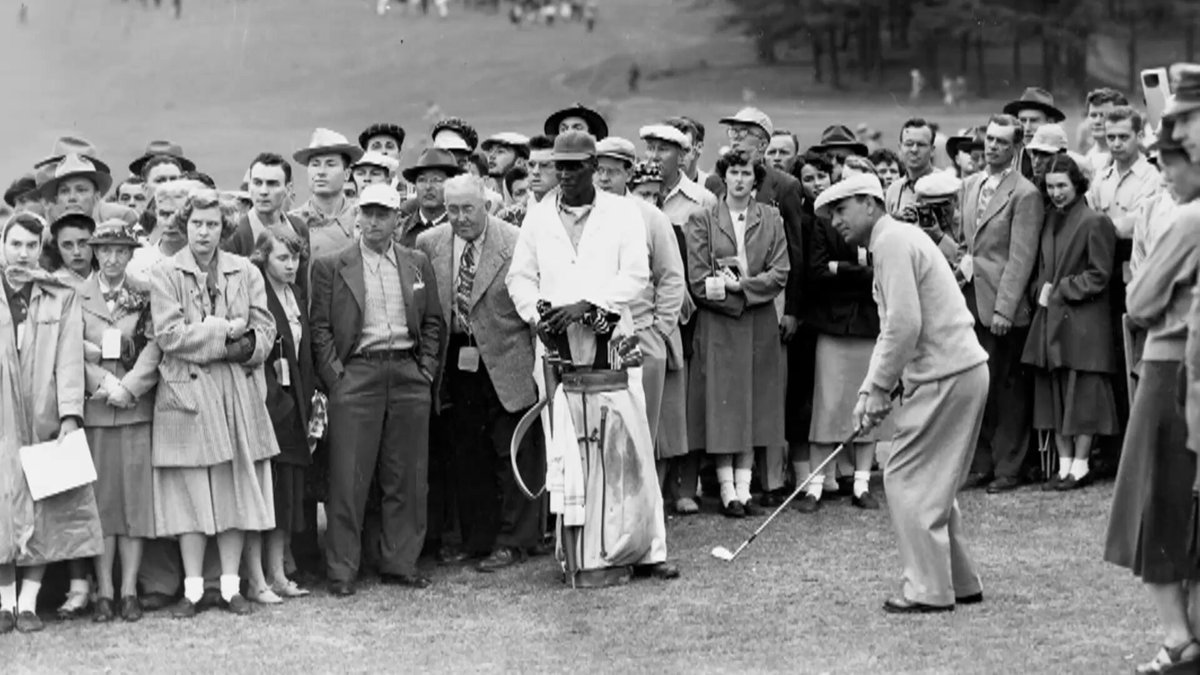
Ben Crenshaw reflects on Ben Hogan’s historic 1951 Masters victory and the character that defined a Texas golf icon.
Ben Crenshaw, himself a two-time Masters champion and golf historian, offered a compelling portrait of his fellow Texan and lifelong hero Ben Hogan as Augusta National marked 75 years since Hogan’s first Green Jacket victory in 1951.
Speaking with passion about a man who shaped the very fabric of competitive golf, Crenshaw highlighted the precision and tactical brilliance that defined Hogan’s approach to the game. “He played a different game than most people,” Crenshaw reflected. “There was like no nonsense in his game in the way that he thought he could get his ball around this golf course without difficulty.”
The 1951 Masters showcased Hogan’s methodical mastery. At 40 years old, he carded a bogey-free final round 68—the only sub-70 round posted that day. His approach was uncompromising. “He wasn’t going to take many chances,” Crenshaw explained. “Such precision. He almost played golf like a machine.”
A Texan Legacy Built on Iron Will
Hogan’s dominance extended beyond that first victory. He claimed his second Green Jacket just two years later, joining an elite group of multiple Masters champions. Yet what struck Crenshaw most profoundly was the character behind the champion.
“He just had this iron will about him that exuded his being,” Crenshaw said. Growing up in Fort Worth, Hogan set the standard for an entire generation of Texas golfers. Crenshaw himself became part of that lineage, winning his own pair of Green Jackets while following in the footsteps of legends.
“What I was most proud of is that I followed a wonderful group of Texans,” Crenshaw reflected. “When you grow up in a state with Ben Hogan, Byron Nelson, Jackie Burke, they’re way up there and you only hope to emulate something close to what they did for our state.”
Among the ten Texans to wear the Green Jacket, Hogan and Crenshaw stand as two of only five to capture it multiple times—a distinction that underscores the depth of Texas golf excellence. The state’s challenging conditions—hard ground, constant wind, unpredictable bounces—forged a different breed of golfer. “You know, if you play hard ground in Texas and you go up east to play, you know, the more predictable bounces,” Crenshaw noted.
A Champion’s Character Defined by Principle
Beyond his playing record, Hogan’s influence on the Masters extended to tradition itself. After his 1951 victory, he established the Masters Champions Dinner—a custom where the defending champion hosts fellow winners at the club’s expense. Yet Hogan’s graciousness had clear boundaries rooted in principle.
When Augusta National offered him a $1,000 travel stipend to attend the dinner, Hogan declined in a handwritten letter to club member Alex Franklin. “Under no circumstances would I accept your generous check for $1,000 and the check is returned for cancellation,” he wrote. “I made the quick trip to Augusta because I wanted to attend the dinner, which I thoroughly enjoyed and while there, did absolutely nothing to earn money.”
Hogan’s message reflected his unwavering work ethic and integrity. “That just kind of shows you the type of person he was. He wasn’t going to accept anything that he didn’t think that he should have,” Crenshaw explained. “He was very businesslike. He meant business every day of his life. Every day of his life.”
For Crenshaw, remembering Hogan meant honoring not just a golfer of unparalleled skill, but a man whose character shaped the traditions and values that continue to define championship golf at Augusta National.
This article was created with the help of AI and editorially reviewed. Report an issue