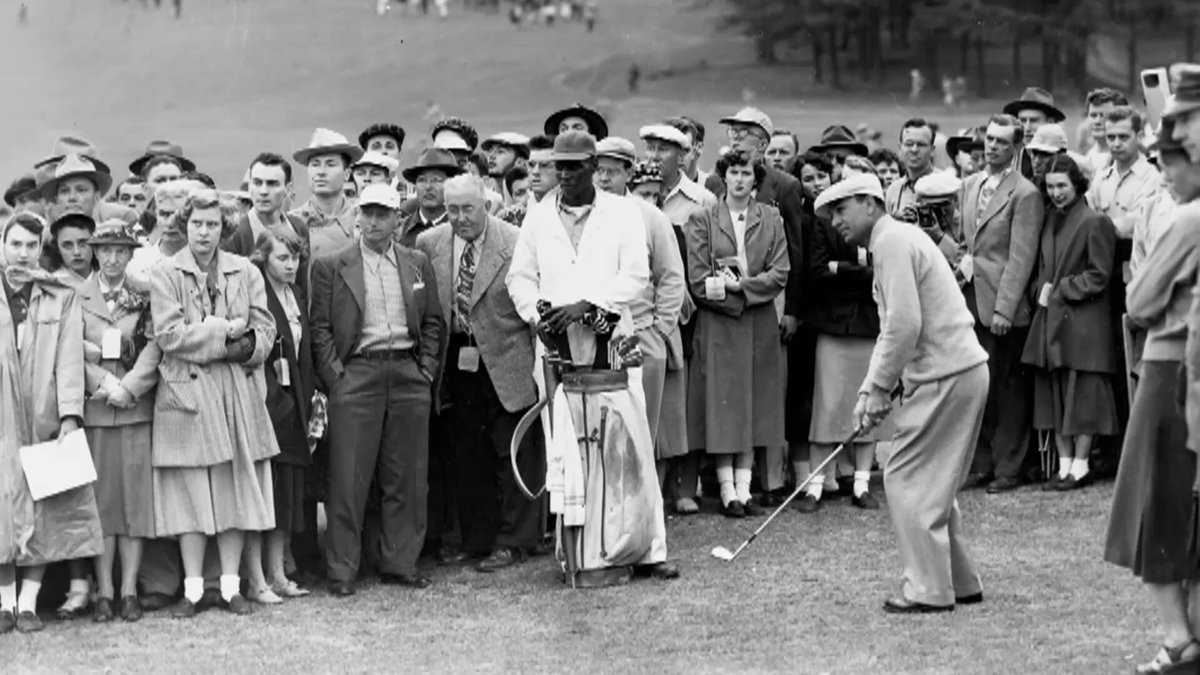
Two Texas legends, separated by generations but united by Green Jackets. Crenshaw reflects on Hogan’s precision and character at Augusta.
Ben Crenshaw has long been recognized as a custodian of golf’s history and traditions, but his admiration for fellow Texan Ben Hogan runs particularly deep. As The Masters marks 75 years since Hogan’s first triumph at Augusta National, Crenshaw offered a compelling perspective on what made the legendary golfer’s approach to the game so distinctive.
“He played a different game than most people,” Crenshaw reflected. “There was like no nonsense in his game in the way that he thought he could get his ball around this golf course without difficulty.” That characteristic approach defined Hogan’s victory in 1951, when the then-40-year-old golfer played with remarkable restraint. His final round 68 was the only sub-70 score of the day—a bogey-free masterclass in course management executed by a tactician rather than a risk-taker.
“The way that he played, people will never forget. Such precision. He almost played golf like a machine,” Crenshaw said, underscoring the mechanical excellence that Hogan brought to every shot.
A State Built on Champions
Both Crenshaw and Hogan represent a remarkable tradition. Texas has produced ten Masters champions, with Crenshaw and Hogan among only five who have won multiple Green Jackets. Growing up in a state with such golfing pedigree shaped Crenshaw’s own aspirations. “When you grow up in a state with Ben Hogan, Byron Nelson, Jackie Burke, they’re way up there and you only hope to emulate something close to what they did for our state,” he explained.
The Texas environment itself—with its unpredictable wind, hard ground, and difficult conditions—forged a particular type of golfer. “If you play hard ground in Texas and you go up east to play, you know, the more predictable bounces,” Crenshaw noted, suggesting that Texas bred a certain resilience and adaptability.
Character Beyond Competition
Hogan’s influence extended far beyond his playing record. After winning his first Masters, he initiated the tradition of the Masters Champions Dinner, where the champion picks up the tab—a custom that continues today. Yet even in this gesture of victory, Hogan’s character shone through in an unexpected way.
When Augusta National offered him a $1,000 travel stipend to attend the dinner, Hogan declined it in a letter to club member Alex Franklin. “Under no circumstances would I accept your generous check for $1,000 and the check is returned for cancellation,” he wrote. “I made the quick trip to Augusta because I wanted to attend the dinner, which I thoroughly enjoyed, and while there, did absolutely nothing to earn money.”
Hogan went on to explain that everything about the trip was a pleasure, and he could not in good conscience accept compensation for something he did not earn. “That just kind of shows you the type of person he was,” Crenshaw said. “He wasn’t going to accept anything that he didn’t think that he should have. He was very businesslike. He meant business every day of his life.”
This anecdote reveals the iron will that defined Hogan as both a competitor and a man. Two years after his first Masters victory in 1951, Hogan won his second Green Jacket, cementing his place among the game’s all-time greats. For Crenshaw, honoring that legacy is simply a matter of respect—one Texas champion paying homage to another.
This article was created with the help of AI and editorially reviewed. Report an issue