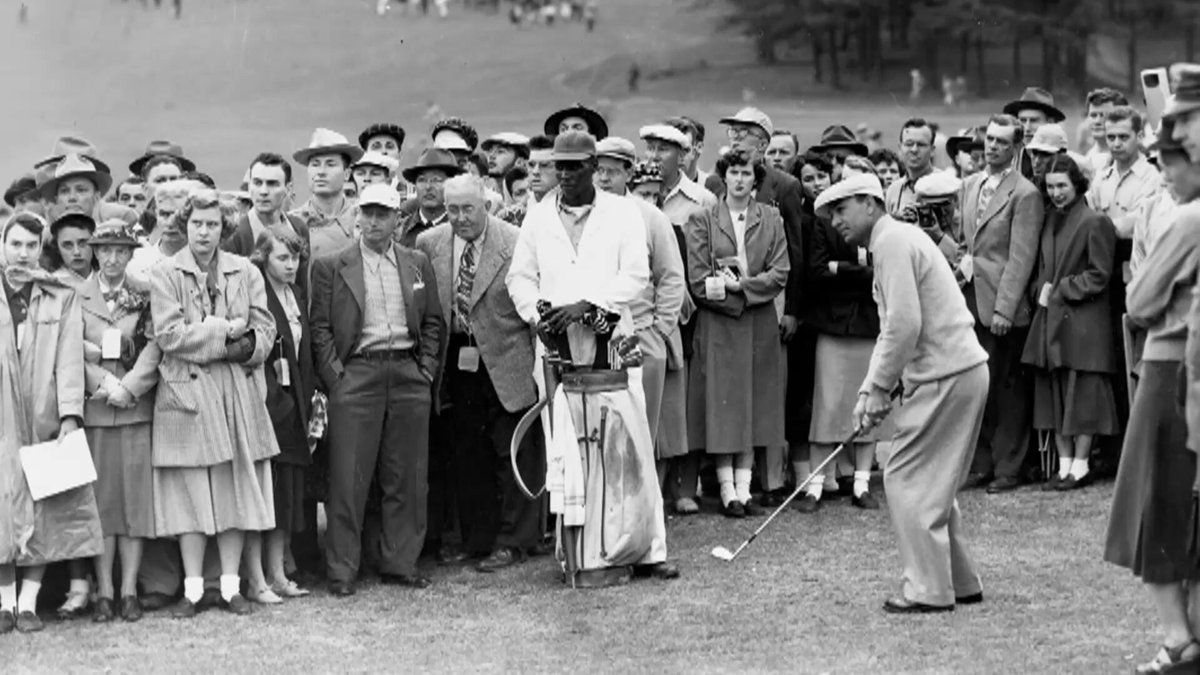
Two-time Masters champion Ben Crenshaw shares insights into fellow Texan Ben Hogan’s first Green Jacket victory 75 years ago.
Ben Crenshaw, a two-time Masters champion himself, recently reflected on one of golf’s greatest figures and fellow Texas legend Ben Hogan, whose first Masters victory occurred 75 years ago in 1951. In a tribute that underscores the deep connection between two of the sport’s most accomplished Texans, Crenshaw detailed what made Hogan’s approach to golf at Augusta National so distinctive and enduring.
“He played a different game than most people,” Crenshaw explained, emphasizing Hogan’s methodical and precise approach to the course. “There was like no nonsense in his game in the way that he thought he could get his ball around this golf course without difficulty.”
Precision and Iron Will
At age 40, Hogan demonstrated remarkable composure during his first Masters triumph. He carded a bogey-free final round of 68, which stood as the only sub-70 round recorded that day. His tactical approach reflected a champion unwilling to take unnecessary risks on the demanding layout of Augusta National.
“Such precision. He almost played golf like a machine,” Crenshaw noted, capturing the essence of Hogan’s mechanical efficiency. “He just had this iron will about him that exuded his being.” This unwavering determination became a hallmark of Hogan’s legacy, distinguishing him from his contemporaries and establishing a standard for competitive excellence.
Hogan’s success at Augusta was not limited to 1951. He claimed his second Green Jacket just two years later, cementing his place among the sport’s elite champions. Crenshaw himself followed in this tradition, winning two Masters titles and becoming part of an exclusive group of Texas champions.
Texas Golf Legacy
The state of Texas has produced ten Masters champions, a remarkable achievement that reflects the region’s deep golf culture and challenging playing conditions. Among these ten, only five have won the tournament multiple times, a distinction shared by both Hogan and Crenshaw.
“What I was most proud of is that I followed a wonderful group of Texans,” Crenshaw reflected. “When you grow up in a state with Ben Hogan, Byron Nelson, Jackie Burke, they’re way up there and you only hope to emulate something close to what they did for our state.”
Growing up in Texas provided unique preparation for championship golf. “You had the weather, always the wind is blowing, sometimes you had hard ground to play. It was difficult conditions,” Crenshaw explained. “You know, if you play hard ground in Texas and you go up east to play, you know, the more predictable bounces.” This foundation in adversity shaped the character and adaptability of Texas golfers.
A Champion’s Principles
Beyond his on-course achievements, Hogan’s character revealed itself in his personal convictions. Following his 1951 Masters victory, Hogan initiated the Masters Champions Dinner tradition, where the defending champion hosts fellow winners at their own expense—a practice that continues today.
When Augusta National offered Hogan a $1,000 travel stipend to attend the dinner, he politely but firmly declined in writing to club member Alex Franklin. “Under no circumstances would I accept your generous check for $1,000 and the check is returned for cancellation,” Hogan wrote. “I made the quick trip to Augusta because I wanted to attend the dinner, which I thoroughly enjoyed and while there, did absolutely nothing to earn money.”
Hogan’s letter continued with characteristic graciousness: “Please understand my thinking because everything about the trip was a pleasure to me. I wanted to chat with you while you were there, but the clock just kept running away. Nevertheless, thanks again to you and others of the committee for even thinking of compensating me.”
Crenshaw’s assessment of this gesture encapsulated Hogan’s essence: “That just kind of shows you the type of person he was. He wasn’t going to accept anything that he didn’t think that he should have. He was very businesslike. He meant business every day of his life. Every day of his life.”
This article was created with the help of AI and editorially reviewed. Report an issue